
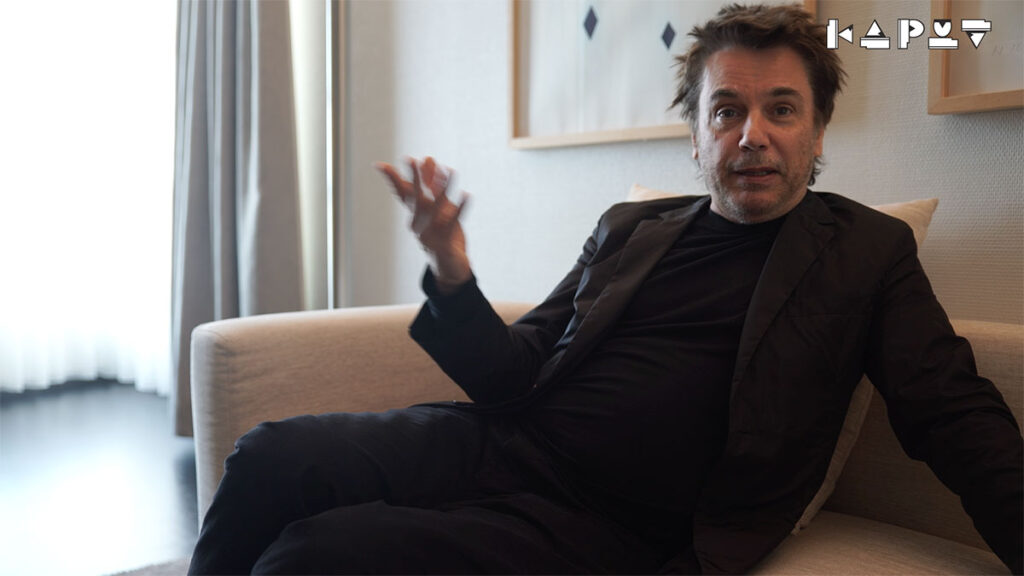
At 67, futurist French musician, composer, and producer Jean Michel Jarre shows no signs of slowing down. The son of esteemed film composer Maurice Jarre—known for his soundtracks to “Lawrence of Arabia” and “Doctor Zhivago”—Jarre’s formative years were shaped by Pierre Schaeffer in the early 1970s during the Musique concrete movement. Yet, rather than stay within the academic realm, he took his synthesizer compositions to grand stadiums and unique venues, especially with his iconic album «Oxygéne,» which has sold 18 million copies to date.
This autumn, Jean Michel Jarre will release «ELECTRONICA 1: The Time Machine,” the first of two albums showcasing collaborations with a diverse array of contemporary electronic artists such as Boys Noize, M83, Air, Vince Clarke, Little Boots, Fuck Buttons, Moby, Gesaffelstein, Pete Townshend, Tangerine Dream, Laurie Anderson, Armin van Buuren, Massive Attack, John Carpenter, and Lang Lang.
It’s an impressive lineup, as Jarre himself points out, but each collaboration has its own rationale. Thomas Venker caught up with Jean Michel Jarre to delve into this project and to explore the vital role of curiosity in an artist’s journey.
Mr. Jarre, I’d like to focus on two topics today: your new album «ELECTRONICA 1: The Time Machine» and, secondly, the nature of curiosity. Given the variety of collaborators on the album, it’s likely that your curiosity fuels your creativity. How do you maintain that inquisitive spirit throughout your career?
JMJ: It’s a state of mind. You can cultivate it through childhood education or develop it independently if you choose. It’s fascinating that you initiate this conversation this way, as I believe curiosity is ingrained in my DNA. One of the key elements I share with all my collaborators is a sense of curiosity. Artists like Massive Attack, Air, Moby, and Laurie Anderson all display a common desire for exploration.
These are established artists who seem to have found their signature sound long ago, leading one to question if they are the most curious artists. But when you’re in the studio with them, do you still see the enthusiastic child peeking through?
Today’s music landscape is often about being the flavor of the week. An artist might have their moment in the spotlight once or twice, but that isn’t the ultimate goal. The essence of being an artist lies in the middle ground, and curiosity paradoxically leads to a unique, recognizable identity. I once met Federico Fellini toward the end of his life, and he shared something that resonated with me: «All my life, I thought I was making different films, but at the end, I realized I was always making the same one.» He was referring to various expressions of a singular obsession—a perfect definition of an artist. If we have something to communicate, there’s fundamentally one message we strive to convey through different declarations. The works of The Beatles, Stanley Kubrick, Pablo Picasso, and Johann Sebastian Bach reflect this—they each communicate a consistent theme, which we refer to as style. Curiosity fosters consistency; it’s a vibrant force that isn’t inherently tied to success or trends. A true artist remains unaffected by hype; they might experience it once, only to fade away again.
Among your collaborators for this album, some overlap, while others are surprising choices. Do you genuinely enjoy the music of all these different artists, or do some simply bring an interestingly distinct perspective?
With this project, I aimed to involve people who inspire me, who are part of the same family or tribe. These artists share a common galaxy; there’s a reason for their presence on this album. In today’s show business, it’s standard practice to name drop artists, sending files back and forth without personal interaction, exclusively through managers. Our approach was entirely the opposite. For each collaboration, I physically met the artist. I traveled extensively, which was a source of initial joy for me. The goal was to encounter each artist in their unique environment—Vince Clarke in Brooklyn, Tangerine Dream 100 kilometers outside Jena; I took a train from Paris and then a car to visit Edgar Froese. That was part of the dogma, and it brought authenticity, resulting in something truly special. In our technology-driven world, we often don’t communicate with our neighbors. Though musicians might collaborate occasionally on stage, it’s a rare opportunity to start a project from scratch together. I suspect this mutual connection is why all my contacts agreed to participate.
To revisit your question: there’s a reason for every collaboration. Yes, I appreciate their music; otherwise, I wouldn’t have worked with them.
It’s intriguing that you visited each artist’s studio, rather than having them come to you as the project’s initiator. Did you believe the most artistically engaging results could only emerge from stepping into their environments? Take Tangerine Dream, for instance—engaging with their setup instead of your own…
It was a fascinating experience confronting my habits and rituals, just as it was for everyone involved throughout the process. It’s about challenging those mundane practices—something you achieve by immersing yourself in someone else’s world. When Moby and I began working together, the first thing he did was play a D-minor chord with three notes on the keyboard. It’s a very basic approach, yet it establishes style. He adopts a Jackson Pollock-like composing method—layering one sound atop another, focusing on one bar before moving to the next. I approach it differently, starting with a broad vision and gradually drilling down into details. These seemingly minute differences played a fundamental role in shaping this project.
So, in collaborating with Moby, you blended his micro perspective with your macro approach?
Yes, he certainly brought his own vision to the track. Take Laurie Anderson, for example. I’ve known her for quite some time; she’s one of the most influential artists in the New York scene, both musically and visually. Her unique relationship with technology introduced a distinct sound to the studio. I wanted us to collaborate on a song I had written, sending her the music and suggesting that she handle the vocal parts. She agreed, and we brainstormed my concept for a love song that encompassed our relationship with technology—essentially exploring our almost tactile connection with our smartphones. We tend to touch them more than we do our partners.
In this case, Laurie would embody the role of the smartphone. After one night spent writing lyrics, she joined me in the Los Angeles studio for a surreal experience. Initially, I considered processing her voice, but her natural tone was so remarkable that we decided against heavy effects, favoring simplicity and authenticity. Each collaboration emerged organically from its specific context.
I must say, “Rely on Me,” the track with Laurie Anderson, is fantastic, especially following “Zero Gravity,” your collaboration with Edgar Froese of Tangerine Dream. I appreciated that …
… contrast?
Yes, it distinctly highlights the magic of a musical journey.
Thank you for acknowledging that; I intentionally invest significant thought into the album’s order. With Moby, Gesaffelstein, The Who, Laurie Anderson, Armin van Buuren, and Massive Attack featured, it might seem chaotic. Yet, everything forms part of a cohesive journey. Just like during our conversation, you’re considering your next question while enjoying the ambiance—warm lights, blue skies, and aromatic coffee. All these elements contribute to the overall narrative. What excites me about this project, and I can confidently say this as I’m not alone in it, is its diversity, which mirrors societal life today. We possess a yearning to jump around while simultaneously desiring to explore life’s deeper meanings. Consider why Facebook is so successful? People seek to construct meaning in their lives.
Do you perceive a zapping quality within “ELECTRONICA 1: The Time Machine,” given the varied tracks? While I must mention that the actual album doesn’t sound as disparate as the list of collaborators might imply—only “If..!” with Little Boots strongly diverges due to her unique vocal style, alongside contributions from Pete Townshend and Armin van Buuren. However, I sense some individuals gravitated closer to your sound.
Ultimately, it’s my album, not van Buuren’s or Townshend’s. I’m genuinely appreciative that they collaborated with me and allowed me the final say. Regarding the examples you provided—Burren and Townshend—I was intrigued by the creative possibilities merging The Who’s sound with trance. It wasn’t about conventional rock or merely festival beats; I appreciate the joy in trance music that echoes a hint of neoclassical elements. In essence, I’m describing soundscapes. With Armin, we set off in this direction. As for Pete, we shared a unique connection for various reasons. He was the pioneering force behind integrating sequencers and electronic sounds in rock music with “Baba O’Riley,” a tribute to Terry Riley. He’s slightly older than me, and while he was doing this, I was an assistant preparing sessions for Terry Riley in Paris. Moreover, Pete is the original creator of the rock opera as an art form. During my studies, I was completely engrossed in German opera, particularly Wagner’s work, which aims to transcend traditional music by collaborating with carpenters, filmmakers, and painters. That influenced how I prepared for my concerts, incorporating the talents of my contemporaries in video and electronic lighting. Essentially, I envisioned creating my take on The Who’s sound—sort of a mini electronic rock opera. To date, you’ve only heard one-third of the pieces we collaborated on; I’m reserving the more complex ones for the second album.
Returning to the topic of curiosity, your father was also a composer. What lessons did you learn from him?
Regrettably, I wished I could have learned from him, but my parents separated when I was five, and our relationship was nearly nonexistent. He resided in America while I was in Europe. Often, having an open conflict with your father might be more beneficial than having no relationship at all—nothingness can be the most challenging. He passed away five years ago, and it took me a long time to come to terms with this. So to address your question: I probably cultivated my curiosity out of frustration, trying to explore independently in the absence of my father’s guidance on how to navigate life as an artist. I learned to fend for myself. I hadn’t contemplated this before, but I realize now that I am indeed a very curious person; it’s intrinsic to my life.
There’s a story about your mother taking you to a jazz club on your birthday to see Chet Baker perform.
My mother was a notable figure in the French resistance during World War II. Captured by the Nazis three times, she managed to escape each time. She was truly extraordinary. After the war, she became close to a woman who opened the first jazz club in Paris, Le Chat Qui Pêche. I would often accompany her there on weekends, listening to the musicians without comprehending their significance—people like John Coltrane, Don Cherry, and Chet Baker. On my 8th birthday, Chet Baker set me on some piano keys and played a song for me—of course, I didn’t know who he was then. That was probably my initial tangible connection to music, and even now, recalling it brings a rush of emotion. It was an almost sexual bond with sound.
It’s moving to hear you describe that. Such moments expand your horizons. Listening to artists like Baker or Coltrane, their music has a texture that ignites a curious journey. It’s multi-dimensional—it’s a sound one wants to explore…
…exactly. You touch on something interesting: I view jazz as akin to abstract painting, with its interplay of texture and layers. This significantly influenced my involvement in electronic music. For me, making electronic music resembles cooking—it’s a sensual, almost erotic activity that involves frequencies and textures in a very tactile manner. This approach centers around tangible experiences. Much like jazz, abstract painting—think Pollock, Dubuffet, and Hartung—focuses on real elements: texture, paint, the physical act of creation, while figures like Renoir or Michelangelo represent a more intellectual world. Electronic and jazz music both resonate with that sensual connection to harmonies and textures, extending beyond mere notes and chords.
You were also mentored by Pierre Schaeffer. In 1969, you joined his Groupe de Recherches Musicales amid the Musique concrete era. Today, you are a seasoned artist—could you pinpoint the moment when you transitioned from student to teacher?
Schaeffer was indeed my mentor. It’s crucial to recognize that electronic music originates from two countries, Germany and France—Pierre Schaeffer and Pierre Henry in France pioneered Music Concrete, while Stockhausen explored electronic sounds in Cologne. This movement stems from Continental Europe, not America. Schaeffer once told me something transformational: “Music consists of more than just notes and harmonies; it encompasses sounds.” Nowadays, DJs often function as sound designers, often unconsciously. I found myself in an intellectual hub, researching and classifying sounds scientifically, but eventually, Schaeffer urged me: “You have everything you need; now go perform. Don’t squander your time in the laboratory; your path lies elsewhere.” That was a pivotal push for me.
Having achieved significant success with Oxygéne and its follow-up «Equinoxe,» how did you manage to leave those sounds behind and create works like «Waiting for Cousteau» or this new album? Did stepping away from familiar, successful sounds require considerable energy, or did it feel seamless?
It felt completely natural. I perceive success as a byproduct of an artist’s failures; we navigate through highs and lows. I always strive to explore new horizons, which circles back to your initial inquiry regarding curiosity. Creativity springs from a blend of innocence, desire, and curiosity. Innocence captures that freshness, which can endure even into old age—without naivety, of course. Desire drives your urge to craft a song with the same passion an architect possesses, adopting a playful attitude that fosters experimentation. Curiosity, on the other hand, fuels exploration and cultivates a beginner’s mindset.
There’s your song «Happiness is a Sad Song,» which might resonate with The Beatles’ “Happiness is a Warm Gun.” Do you find a shared essence in both, albeit expressed differently?
I’ve always been intrigued by how art encapsulates the contrast between happiness and sadness, joy and underlying melancholy. This dichotomy is a trait I admire in all artists I appreciate, from Lars von Trier to The Beatles and Massive Attack. If I were to compile a list of my collaborators on this album, each would exhibit that contrast between innocent joy and deep-seated melancholy as a theme. It embodies the sadness of a clown; as a child, I would cry at the sight of a clown—circus clowns often embody a somber essence.
Interestingly, the first track I produced for «Musik aus Raum und Zeit» was titled «Happiness is a Sad Song.» Should I eventually write my biography, it would serve as an apt title, as it reflects my drive to create music and how I emotionally connect with it. This sentiment also holds true for someone like Chet Baker; «Happiness is a Sad Song.»
Indeed, this contrast resonates throughout various art forms, including film and visual arts. Consider the blue sky, often carrying an inherent darkness.
“Blue Velvet” exemplifies this perfectly. It opens with a serene blue sky, followed by a revelation of darker undertones.
Recently, there’s been a resurgence in the appreciation of vintage synthesizers. Given your reputation for embracing synthesizers, I’m curious about your perspective, especially considering your openness to experimental approaches like working with lasers.
Today, plug-ins can rival original instruments in quality. For me, the idea surpasses the instrument. The remarkable reality of modern music lies in the ability to utilize virtual plug-ins. There’s no hierarchy among instruments anymore; it’s about choosing what best serves the idea you aim to communicate.
For «ELECTRONICA 1: The Time Machine,” you collaborated with Edgar Froese of Tangerine Dream, who sadly passed shortly after. How does that song resonate with you now?
The sentiment is strange. It feels like it should have happened 20 years earlier. Edgar was genuinely touched that I traveled so far to connect with him. For me, the track resides between two realms, foreshadowing the events that unfolded weeks later. It’s the last track associated with Tangerine Dream, and in that context, the record serves as a tribute to Edgar’s memory—a bridge to the timeless nature of music through him.
Do you ponder the enduring quality of your music?
No, not particularly. I think if you start considering it, you inadvertently become tied to the concept of timelessness. To achieve that, you must set aside the notion of time.
Mr. Jarre, I could continue this conversation with many questions remaining, but unfortunately, our time is up!
Fuente original: kaput-mag.com
Publicado originalmente el 2015-10-13 07:00:00 por
Hashtags sugeridos: #perfect #definition #artist #declarations #obsession