
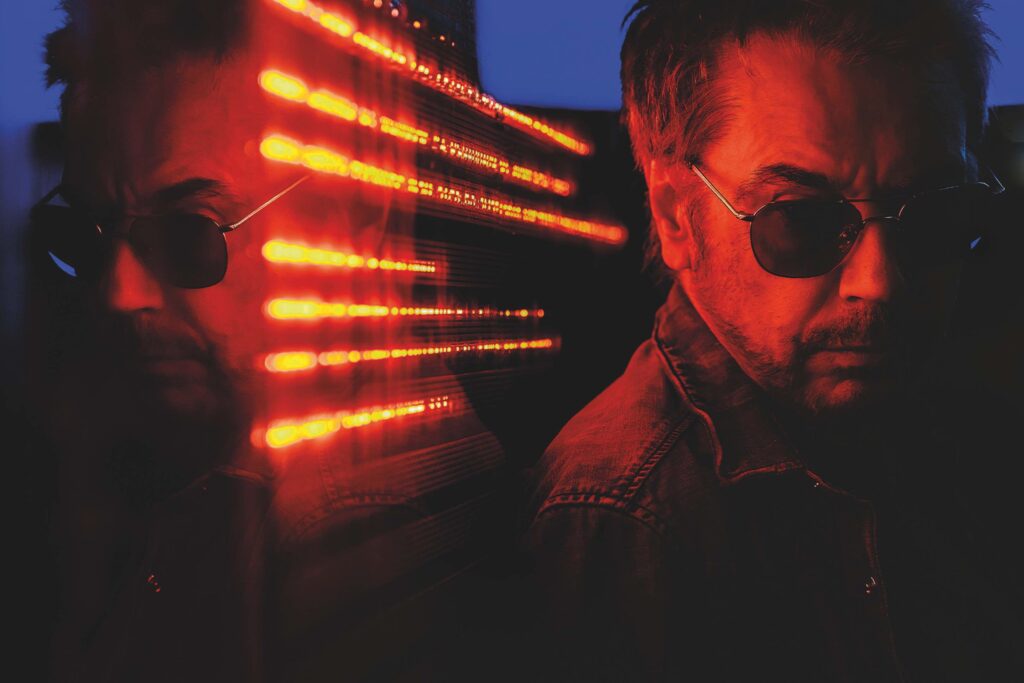
A pioneer of electronica, Jean-Michel Jarre has delivered some of the most stunning live performances in history while continuously looking to the future—currently refining his new album mid-flight aboard a jet…
Simon Button
He shot to fame in 1976 with the best-selling Oxygène, earning him the informal title of ‘Godfather Of Electronica’. More than forty years later, as he reflects on his journey with a two-disc compilation and embarks on a new chapter with an upcoming album, Jean-Michel Jarre shares: “I feel like I was part of the first wave of reimagining music in thrilling new ways, and I feel incredibly fortunate to have been there at the beginning of something transformative.”
Displaying more humility than one might expect from a figure with 80 million album sales credited to his name, Jarre notes: “When I began, I had no guidelines. It was an exhilarating and naive experience to explore uncharted territory. It echoed the beginnings of rock, punk, or any new musical genre, where the focus was purely on enjoyment and experimentation.”
Emerging in the wake of electro pioneers like Kraftwerk and Tangerine Dream, Jarre brought avant-garde sounds into the mainstream. He composed Oxygène in his kitchen’s homemade studio utilizing a mix of analogue and digital synthesizers, various electronic instruments, sound effects, and an eight-track recorder. Initially relegated to obscurity due to its unconventional title, long tracks, and absence of vocals, it eventually launched on a modest French label and reached the Top 10 in eight countries.
Two years later, he followed up with Équinoxe, showcasing a richer, more intricate sound, solidifying his status beyond a one-hit wonder. Although it didn’t match its predecessor’s colossal sales, it achieved a commendable No.11 in the UK charts and remains a beloved album among fans. This has led Jarre to revisit it in his latest work—a decades-later sequel, Equinoxe Infinity, which contemplates the evolution of the blue aliens known as Watchers from the original cover over the past 40 years.
“I thought it would be fun to explore their transformation,” Jarre reveals to Classic Pop from his home in Paris. “They symbolize the evolution of technology, resembling artificial intelligences observing and studying us. For the first time, my starting point wasn’t musical but visual.”
However, he refrains from labeling the new album as a direct sequel, considering it more of an evolution. “It respects the original structure but amplifies it. It remains faithful to electronic music, but poses the question: ‘If I were creating the original album today, what instruments would I use?’ I’ve blended analogue instruments with contemporary ones to create a bridge between the two worlds.”
The Joy of Repetition
Musically, Jarre feels he remains true to his roots. “The process of merging sounds and developing structure has largely remained constant throughout my career,” he explains. “I recall the Italian filmmaker Federico Fellini telling me at a festival shortly before his death: ‘Throughout my career, I thought I was directing different films, but now I realize I’ve been making the same film.’ That resonates with me.”
“I believe many artists with a distinct style experience a similar journey, regardless of their medium. Think of Quentin Tarantino, The Beatles, Salvador Dalí, Francis Bacon—each persona echoes a singular narrative throughout their artistic expression.”
Yet, the technical side of recording has transformed dramatically since Oxygène, which spanned eight months to create. Just prior to our conversation, Jean-Michel was on a plane listening to the original mastering of Equinoxe Infinity and made some tweaks mid-flight. He managed to connect to Wi-Fi upon landing, sent the revisions to his mastering engineer, attended a business meeting, and by the time he reached his hotel, the updated masters were ready for his approval.
“Fifteen years ago, I’d have needed to return to the studio to remix with a sound engineer and then revisit the mastering studio—a process that would take three or four days. Now, technology has accelerated the process significantly, altering our relationship with time and space.”
His new album embraces the recent release of Planet Jarre, a curated four-part, 41-track retrospective available on two CDs or four LPs.
“Generally, I’m not a fan of compilations or greatest hits,” he admits. “Sometimes they work well when artists perform singular songs, but each of my albums embodies an overarching concept, making it challenging to select one excerpt, akin to extracting a single scene from a film or a chapter from a book.”
“I decided, however, that if we proceeded with this project, I should approach it innovatively. Reflecting on my body of work, I recognized I have four distinct approaches, prompting me to create this album in four segments, each representing different styles and ambiances linked to my varied methods.”
This led to discs dedicated to Soundscapes (ambient, atmospheric compositions inspired by classical and film music); Themes (melodic, song-like electronic pieces); Sequences (hypnotic electronica); and Explorations & Early Works (which summarizes itself). This section includes the demo of Music For Supermarkets—a coveted gem for fans initially pressed on vinyl for auction and aired on radio before Jarre destroyed the master tapes as a statement against mass production in music.
Oxygène of Publicity
The release of Planet Jarre coincides with a particularly busy year for Jean-Michel, who’s been finalizing Equinoxe Infinity and touring the U.S., where he made his festival debut at Coachella to great acclaim.
Reflecting on his early career, he finds humor in the fact that he never expected to still be thriving decades later. He recalls a conversation with Mick Jagger, who mentioned that when The Rolling Stones skyrocketed to fame, he thought it would only last two years. “I felt exactly the same,” Jarre chuckles.
The son of renowned film composer Maurice Jarre, Jean-Michel was raised by his mother after his parents divorced when he was five, while Jarre Sr. moved to America. He studied classical piano, mastered violin, graced jazz, and began experimenting with electronic sounds. Initially, his early albums went largely unnoticed until Oxygène became a groundbreaking success—unfogged by any realization at the time that it would achieve greatness.
“It wholly surprised me. The album was so unique and was rejected by numerous record companies, with them saying: ‘What is this? You have no drummer, no singer, and no potential singles or short radio tracks,’” he laughs. “Plus, it was French.” The album cover, depicting Earth’s surface peeling away to reveal a skull, further confounded people. Even my mother questioned: ‘Why name your music after a gas with a skull on the cover?’”
Eventually, the album debuted on a small French label and was later licensed to Polydor, gaining traction only after Radio 1 broadcast the entire album one night, subsequently inspiring other radio stations across France and the Netherlands to follow suit. “Abruptly, it took off, and the success was extraordinary, but capturing that magic again is impossible. The pressure surrounding the follow-up album is entirely different; while no one was waiting for the first, everyone awaits the second.”
Awards, Tours
Nevertheless, Jean-Michel has achieved remarkable success, earning Silver, Gold, and Platinum discs, a plethora of accolades, and numerous entries in the Guinness Book Of Records for his spectacular concerts. Despite the recent release of the Planet Jarre retrospective, he states: “I’m not one to dwell too much on the past.”
If required to pick a favorite among his 20 studio albums, it would likely be Zoolook, his ambitious 1984 release that integrated speech and singing in 25 languages, described by NME as a fusion between Kraftwerk and Scary Monsters-era Bowie. “I take great pride in that album, but I’m always more thrilled about the work I’m doing now, and I must admit I’m rather satisfied with this new Equinoxe. It serves as a strong connection between my previous and current work.”
Another pinnacle of his career has been his Electronica project, which comprised two albums—The Time Machine in 2015 and The Heart Of Noise the following year—featuring collaborations with renowned artists like Massive Attack’s 3D, Pet Shop Boys, Armin Van Buuren, Pete Townshend, and Vince Clarke. “These are incredible artists who have inspired me immensely, and I aspire to develop this as a side project in the future, collaborating with musicians across multiple generations. The realms of rock, hip-hop, or jazz often foster collaboration, while electronic music tends to be a solitary endeavor in the studio. It’s infrequent to share the thrill of creating music together, which is why I cherish opportunities to work with such remarkable artists.”
Jarre’s legendary live performances began breaking records in 1979, when he performed at Place De La Concorde in Paris for Bastille Day to a crowd of a million, earning his first Guinness Book Of Records entry. He shattered this record in 1986 when 1.5 million attended the spectacle for NASA’s 25th anniversary in Houston. Since then, he has bested his own record twice, drawing 2.5 million in Paris in 1990 and an astounding 3.5 million for his Moscow show seven years later. Jarre was also the first Western artist invited to perform in post-Mao China and has graced diverse locales like the Sahara Desert and London’s Docklands.
“I could write a book detailing the entire saga surrounding that,” he muses about his delayed Destination Docklands event, which took place over two nights in October 1988 to promote the Revolutions album.
Although attendance of 120,000 for his Twelve Dreams Of The Sun spectacle in Egypt across New Year’s Eve 1999 and New Year’s Day 2000 may seem modest by his standards, the Pyramids provided a breathtaking backdrop.
“That was truly special,” he understated. “We spent around three months preparing for the show, and amusingly enough, most of the crew eventually stopped wearing watches. The perception of time transformed around the Pyramids. It’s a remarkable, mystical place, with a magnetic aura. I feel fortunate to have performed in such extraordinary venues throughout my life—so many exceptional experiences.”
The Eternal Quest
What the audience perceives isn’t always aligned with his vision; like the time fog obscured the Pyramids, preventing many of his planned projections from being displayed.
“However, if you realize 60% of what you envisioned, I think that’s impressive. You must push the limits of every project to its fullest because, honestly, perfection is unattainable. Numerous variables arise—based on diverse cultures and a spectrum of social, political, and cultural factors—leading to many considerations. It’s a stark contrast to executing a standard tour. One-off events demand entirely different skills, akin to filming a movie in a single night.”
Having turned 70 in August and currently planning his next tour in support of Equinoxe Infinity, Jarre shows no signs of slowing down. “As artists, we’re eternally driven by the pursuit of crafting the ideal album, film, or novel,” he reflects. “It remains a quest, and just when you believe you’ve grasped it, it slips away. It’s like running in the desert—hope propels us forward.”
He chuckles: “I likely spend more time with musical instruments than with people, and it’s not by choice—it’s an addiction. The thrill persists, as long as I maintain my health and my body continues to support me.”
Pete Townshend, with whom Jarre collaborated for both Electronica albums, serves as an inspiration. “While working on a track in his studio, it felt like I was staring at a 17-year-old, as enthusiastic as ever. He remained the same Pete who recorded My Generation.”
“To me, that’s the essence of being an artist—it’s timeless. Some artists reach a point where they claim, ‘I’ve accomplished everything I wanted to do,’ and they stop. And why not, if that’s their sentiment? But for me, I don’t feel I should stop, as I remain engrossed, curious, and receptive to new experiences. With the advancements in technology, this is the most exhilarating era for music creation.”
Fuente original: www.classicpopmag.com
Publicado originalmente el 2025-04-13 07:00:00 por
Hashtags sugeridos: #Infinity #JeanMichel #Jarre #interview