
Sure! Here’s the rewritten content with the same HTML tags preserved:
—
We recently had the opportunity to interview Jean-Michel Jarre, a pioneer in electronic music for over four decades. His first international hit album, Oxygene (iTunes), surpassed 12 million in sales. To date, he has sold over 80 million albums. He is well-known for his breathtaking large-scale concerts and has made history for drawing the largest audience at a live concert (for the fourth time) with 3.5 million attendees at his Moscow concert celebrating the city’s 850th anniversary. The last two years have been especially fruitful for Jean-Michel, marked by the release of three albums: Electronica 1 (iTunes), Electronica 2 (iTunes), and Oxygene 3 (iTunes). Remaining at the forefront of innovation, Electronica 1 received a Grammy nomination. He will bring his Electronica tour to the Greek Theatre in Berkeley on May 26th, marking his first North American tour. Expect a captivating blend of visuals and music, so be sure to secure your tickets here.
SF Bay Area Concerts: First off, I want to thank you for this conversation and congratulate you on the success of your latest three albums. To kick things off, what inspired you to revisit Oxygene while you were engrossed in the Electronica project?
Jean-Michel Jarre: It’s interesting because while I was deep into the Electronica project, I created a track that didn’t quite fit. I thought, if I were to make Oxygene today, this would serve as the foundation. I held onto that thought. When the record company approached me last year about possibly crafting a special edition box set for Oxygene, I felt it would be a refreshing shift after the intricate production of Electronica. It made me want to return to a more minimalist approach, reminiscent of the original Oxygene process when I recorded everything on 8 tracks with a tape recorder over six weeks! So, last summer, I locked myself in for six weeks with a philosophy of limiting myself to no more than eight elements at any given time on the album.
SFBAC: Did you find joy in revisiting that simpler, more ‘analog’ or ‘garage’ approach?
JMJ: Interestingly, I went back to the concept but didn’t aim to use the same instruments. I thought, if I were creating Oxygene in 2016 as a kid, what would I choose? Certainly not just the old analog gear. So, I selected a range of instruments—both digital and analog—available in my studio, which includes a considerable amount of analog equipment. For Oxygene 3, I used my vintage VCX3 from EMS and tweaked a 2600 path, alongside first-generation analog synthesizers, and even plug-ins from Native Instruments and an iPad. But why Oxygene 3? When I crafted the first Oxygene, it was like one extended piece of music comprised of various segments, with no titles for the tracks, similar to a book’s chapters. I’ve always thought it would be fascinating to create sequels to this project. This idea has lingered with me ever since the inception of the first one, as I recognize the rarity of musical sequels. Hence, one reason for Oxygene 3.
SFBAC: With your music, it often calls for a complete listening experience. In today’s shuffle culture, do you foresee a continuous mix of Oxygene 1, 2, and 3 in the future?
JMJ: It’s quite perplexing because over the past decade, we’ve all tended to consume music—including visuals—in shuffle mode. Yet, there’s a growing desire for deeper engagement with cultural content. People are willing to spend a weekend binge-watching series like House of Cards or Game of Thrones. This indicates that while we often jump around online, we are also capable of immersing ourselves in longer experiences. This aligns with my vision for Oxygene and specifically Oxygene 3, where one track really spans 40 minutes. While listeners can select individual parts, my intention is for Oxygene 3 to be one cohesive 40-minute piece. The original was crafted with vinyl constraints in mind—20 minutes on each side. I think of Oxygene 3 as having two sides too, representing darker and more melodic themes.
SFBAC: You’ve staged some of the most remarkable concerts ever, drawing millions. What do you believe about your music allows it to shine in both grand venues like the Houston skyline or the Place De La Concorde and intimate settings like the Greek Theatre without losing its essence?
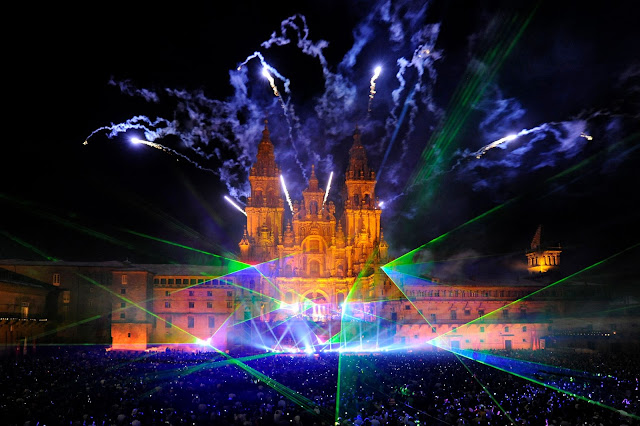
JMJ: I’ve always believed that electronic music should be complemented by visual performances. I’m among the pioneers to integrate visuals extensively in my shows because I understand the audience’s visual expectations. When people attend a concert, they’re not just listening with earbuds; they want a full sensory experience. I appreciate outdoor performances, integrating architectural elements with the music. Over time, I’ve realized that the connection between the audience and the performance isn’t strictly tied to whether it’s indoors or outdoors. Initially, many venues were multi-purpose, not specifically designed for music, unlike the well-equipped arenas we have today. My current tour aims to reflect my musical vision through sound architecture, creating depth and varying layers. I’ve dedicated significant time to conceptualizing the visuals for my concert, and during rehearsals for this new design featuring 3D effects without glasses, we were all amazed by how well it translated. It effectively serves as a visual counterpart to the music. The show is highly dynamic; while you may glimpse it online, the live experience is truly immersive.
SFBAC: What sparked your interest in the visual element of music? How early did visuals become essential in your work?
JMJ: Ironically, I’m not a fan of the MTV era. Videos that tell a story can sometimes overshadow the music itself. For this current project in Berkeley, my visuals aren’t about narrative but rather a form of musical orchestration. I envision my shows as interactive experiences, allowing audiences to create their own stories in their minds through the music and accompanying visuals.
SFBAC: Regarding Electronica, with nearly 30 artists contributing over five years, how did this collaborative process unfold?
JMJ: The project came together by connecting with artists within the electronic scene who have inspired me, regardless of their generation or style. When I reached out to them, they enthusiastically accepted! The outcome was over two and a half hours of music. My two guiding principles were to meet with each artist in person and collaborate in their or my creative space. I also brought along existing pieces or demos as a starting point, leaving space for them to add their uniqueness.
SFBAC: That collaboration is evident in both albums, showcasing the essence of each collaborator while keeping your signature style intact.
JMJ: Exactly! That’s precisely what I aimed for—a true collaboration where the balance is 50/50. I was meticulous in the final mix, ensuring it didn’t turn into a patchwork of unrelated songs. I focused on achieving coherence throughout both albums while respecting each artist’s distinctive world.
SFBAC: You collaborated with Laurie Anderson on Zoolook (iTunes), one of your early projects, and again on «Rely on Me» for the current album. How did your approach vary between these collaborations?
JMJ: I’m a huge admirer of Laurie. She is one of the most influential artists from New York’s scene. Collaborating with her is always a delight. In the context of Electronica, we explored the ambiguous relationship with technology. We crafted a song reflecting a peculiar love story between a connected object and a human, where she embodies the object. It parallels themes from the film Her, but our song is more focused on the physical object itself, highlighting how people often engage more with their devices than their partners. This concept laid the groundwork for our collaboration.
SFBAC: In terms of representing the Electronica albums live, how did you translate these collaborative efforts to the stage?
JMJ: From the outset, I realized getting all collaborators on stage would be challenging, so I planned to base my next tour on Electronica songs without relying on their presence. If they can join, wonderful, but if not, the show will go on. With numerous tracks to choose from, it wasn’t too difficult to perform without the collaborators. Instrumental tracks are straightforward, as we can capture all parts live. For songs with Pet Shop Boys, we create live versions using vocoder-enhanced vocals, which have worked surprisingly well.
SFBAC: Is there an Electronica 3 on the horizon?
JMJ: Honestly, not at the moment. A friend of mine jokingly said I’ve invented the concept of the never-ending album. I have no immediate plans; I truly enjoyed the collaborative journey and learned immensely from it. In the future, I aim to work with others but not specifically for Electronica 3 right now. I’ve just released three albums in 14 months; that’s enough for now. Additionally, I’ve received requests for collaborations on other projects, like with Damon Albarn from Gorillaz, who visited my Paris studio. We spent a couple of days working together, and I’m curious to see where that leads.
SFBAC: Do you take satisfaction in releasing three well-received albums 40 years after Oxygene? Does it feel gratifying to still lead the charge in electronic music innovation?
JMJ: That’s an intriguing question. Like many artists, we create music not for fame or money but because it’s our passion. I’ve always believed that one day, electronic music would permeate everything, and I wouldn’t be here anymore. I feel more in tune with the current times as a musician today than I did two decades ago.
SFBAC: Finally, can you share a bit about the upcoming Zero Gravity concert in Masada at the Dead Sea?
JMJ: Masada presents a fascinating and exciting project tied to my role as a UNESCO ambassador for the environment. A year and a half ago, I visited and was shocked by the state of the Dead Sea. It’s losing 1.2 meters annually. In just over a decade, the area between Jordan and Israel may be devoid of water. I thought a concert there could raise awareness. The location also feels otherworldly, resembling the moon. Interestingly, Masada sits 900 meters below sea level yet has 10% more oxygen than anywhere else.
SFBAC: Thank you, JMJ, for taking the time to chat with us. We’re eagerly anticipating your show at the Greek Theatre in Berkeley on May 26th.
JMJ: I appreciate the conversation, and I’m excited about this North American tour! Each night will present a unique experience, especially the Greek Theatre, which is a fantastic venue.
Interview by Eugene O’Callaghan for SF Bay Area Concerts
Fuente original: www.sfbayareaconcerts.com
Publicado originalmente el 2017-02-17 08:00:00 por
Hashtags sugeridos: #Interview #JeanMichel #Jarre