
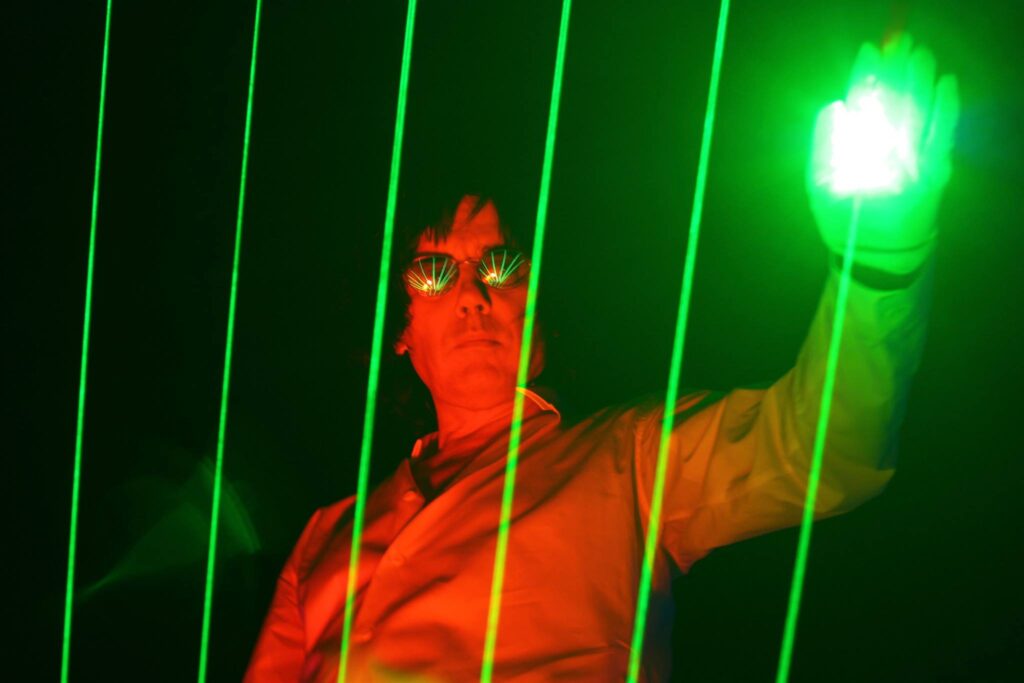
Jean-Michel Jarre. Facebook
Jean-Michel Jarre is a legendary figure in electronic music.
The French composer and performer has achieved remarkable success, selling 80 million albums globally. He is celebrated for his innovative synthesizer-centric albums like Équinoxe and Magnetic Fields, as well as his breathtaking visual performances in front of massive crowds, such as the 3.5 million attendees in Moscow in 1997 (a record recognized by Guinness). In Europe, he performs in arenas and is deeply engaged with his array of keyboards, rather than merely DJing.
2016 marked a significant year for Jarre. His latest two-album series, “Electronica” (Electronica 1: The Time Machine and Electronica 2: The Heart of Noise), received critical acclaim and included a diverse range of collaborations with artists like M83, Peaches, Tangerine Dream, John Carpenter, The Orb, Fuck Buttons, and Moby. Electronica 1 earned him a second Grammy nomination in the Best Dance/Electronic Album category.
His most recent album, the exquisite Oxygène 3, has just launched in America, completing a trilogy that began in December 1976. He plans to tour the U.S. around May and June.
In a recent interview with the Observer, Jarre discussed his new music, legacy, and how a 68-year-old musician appears 20 years younger.
(youtube https://www.youtube.com/watch?v=t_AEhYGFp0U?list=PLWLnfqTVZWVKeJjj6315FjBZ60Yp0YsbW&w=560&h=315)
Oxygène 3 has finally arrived!
The concept for Oxygène 3 emerged while I was working on the “Electronica” project. Three years ago, I created a piece of music that didn’t quite fit within Electronica. I thought if I had to create Oxygène today, I would probably start with this particular track, so I kept it in mind. Then last year, when my record label mentioned the 40th anniversary of Oxygène, suggesting a special box set with bonus content, I realized it would be a perfect opportunity to set a deadline for crafting the final chapter of Oxygène.
I have always appreciated series in literature, film, and television, which are less common in music. The idea of reusing the same sounds or themes but placing them in a fresh context—a storytelling approach—was what the original Oxygène was all about. Its sections are simply titled one to six, similar to chapters in a book.
The first Oxygène took six weeks to create using eight tracks with a minimalist approach. At that time, I had limited electronic instruments, which were quite costly, so we faced technical and financial constraints. After completing the vast “Electronica” project, I thought it would be exciting to isolate myself in the studio for six weeks to craft an album using only a few instruments and no more than eight elements at any time throughout the album.
Additionally, the original Oxygène was produced during the vinyl era, with a conscious effort to keep each side around 20 minutes. I would say Oxygène 3 has two distinct sides—one darker and the other lighter.
Jean-Michel Jarre. Daniele Dalledonne/Flickr Creative Commons
Tracks like “Oxygène 16” and “Oxygène 17” remind me of the ambient techno trend that surfaced in the ’90s, even though that music was more heavily beat-oriented compared to your current work. You seem to utilize beats in a more understated manner than much of EDM.
It’s intriguing because one of the principles I followed while creating the first Oxygène was to use drum machines in a non-intrusive way. After working on “Electronica” with some heavily beat-driven tracks, I wanted to create an album where the groove emerges from sequencers and melodic lines.
In the case of “Oxygène 17,” the groove arises from electronic patterns rather than beats from drum machines. I believe there’s a contemporary evolution of this approach to electronic music that isn’t strictly ambient but maintains a groove without relying on kick or snare beats.
What’s your view on contemporary EDM?
The U.S. tends to categorize all electronic music under the label “EDM,” but of course, electronic music predates artists like Avicii.
EDM is a facet of electronic music, but many EDM artists and DJs often produce tracks targeted for dance floors, while sometimes venturing into different realms. Currently, it seems the EDM scene is shifting toward pop. If you examine the EDM hits of the last couple of years, they increasingly resemble mainstream pop rather than true electronic music.
It’s more like dance-pop with vocals and beats, where the electronic component is becoming less pronounced.
(youtube https://www.youtube.com/watch?v=kSIMVnPA994&w=560&h=315)
“Oxygène 18” is quite ambient. When ambient music became popular in the mainstream during the ’90s, it was often stylized as ambient dance music rather than the ethereal sounds of the ’70s. The acid jazz of the ’90s wasn’t genuinely acid jazz, but rather a sampling and reformatting of those styles into a more structured form. It seems there was confusion around those genres in the ’90s, especially among those drawn to the more beat-centric styles.
That’s very accurate.
In the ’90s, many artists were experimenting within genres that were often misinterpreted as the originals, leading to established styles being absorbed by others.
Precisely. It’s interesting because many people associate ambient music with the absence of a kick.
For instance, if you consider “Oxygène 18” or “19,” introducing a strong kick could easily transform them into an EDM remix, despite lacking heavy drums. This alteration can completely change the perception of the music.
I’ve always admired jazz albums like Focus by Stan Getz and Sketches of Spain by Miles Davis, which largely minimized the role of the drummer. In Sketches of Spain, the approach is organic and distinct, emphasizing texture rather than mere rhythm. By sometimes removing the beats, you can truly focus on the texture and the organic qualities of the sound.
While advancements in technology continuously enhance possibilities, there’s something special about the more laborious analog processes you experienced in the ’70s.
In a way, the process in the ’70s was much more innocent due to the lack of benchmarks. It’s a privilege to embark on a musical journey on unexplored ground when there’s little precedent. Meanwhile, a contemporary artist begins their electronic music journey weighed down by decades of development and influence.
This mirrors the early days of rock music—there was an innocence that fostered freshness, which is likely harder to achieve now due to ongoing comparisons between genres.
I recall that at one stage, my albums were categorized in the New Age section in the U.S., something I found amusing because to me, “New Age” evoked images of artists practicing yoga on mountaintops while using flutes and bells—essentially acoustic and untouched by technology. New Age represents a return to nature, distinctly separate from modern tech.
(youtube https://www.youtube.com/watch?v=TgiSpw-fjOw&w=560&h=315)
The “Electronica” albums feature a wealth of fascinating collaborations. How did you manage to coordinate them all?
For this project, I was keen to meet collaborators face-to-face and engage in a shared creative journey. My second principle was to compose a piece for each collaborator, leaving space for their input. This process extended the timeline, as it turned into an initiation journey across various cities.
It’s amusing because electronic music is closely tied to cities like Berlin, Paris, Detroit, Chicago, New York, and L.A., making it a richly rewarding experience. Every artist agreed to participate, resulting in two albums’ worth of material.
One of my cherished collaborations is with the late Edgar Froese from Tangerine Dream. Was this your initial encounter?
We had a brief meeting before but never truly connected. It’s amusing because I believed Tangerine Dream and I launched our careers simultaneously in the early ’70s, but Edgar insisted I was mistaken, asserting that I started before them. He explained that they began as a prog rock band and transitioned to electronic music later on.
What’s essential to note is that in those days, before the internet, we were very isolated, like vampires in our studios with limited interaction. I vividly recall the first time I encountered Autobahn by Kraftwerk; I assumed it was a California band singing in German, an electronic Beach Boys! It’s fascinating how disconnected we were back then.
Collaborating with Edgar was deeply moving. One of my favorite pieces from this project is “Zero Gravity,” along with the fantastic remix that Above & Beyond created in tribute to him. I took a train to Vienna and drove from there to his home in Austria, unaware that they had prepared a Tangerine Dream version of Oxygène as a surprise. It was a touching moment.
(youtube https://www.youtube.com/watch?v=L7MHhLYecT0&w=560&h=315)
Will you be releasing that collaboration?
Yes, perhaps one day. It was a medley combining one or two tracks.
You also partnered with filmmaker and composer John Carpenter. How familiar were you with his soundtracks before this collaboration? Had you seen many of his films?
I’m a huge fan. I admire all his B-movies, which are masterpieces made on small budgets, reflecting significant aspects of American society during that era. They are timeless, and he is renowned for utilizing synthesizers and electronic instruments for his scores. Collaborating with John Carpenter was top of my wish list; I couldn’t imagine completing the “Electronica” project without him.
You introduced a new kind of 3-D technology during your recent European tour. Can you elaborate on that?
I designed the technology myself. I dislike 3-D experiences with glasses, as they dim the brightness by 50 percent. This technology feels like the early days of cinema when people watched films in circuses—it lacks depth and merely creates simplistic effects.
True 3-D should eliminate the need for glasses. I wanted to visually express the perspectives, architectural sounds, and soundscapes I’ve always been interested in music. I utilized low-resolution screens with many transparencies and was initially apprehensive about its effectiveness. However, during the first rehearsal, we were astonished by how well it turned out.
This technology is closely tied to the music, which ultimately makes the visuals in my concerts exciting. I increasingly consider myself an anti-MTV performer. Relying solely on a sequence of video clips misses the essence. A concert offers a unique experience beyond what you can access on a computer.
Jean-Michel Jarre. Facebook
It seems that many contemporary rock and pop artists rely less on their stage presence due to advancements in technology. Unlike the physical performances we see in live clips from the ’70s and ’80s, today’s performances feel less about the artist and more about the technology.
You’re right. In my shows, I strive to avoid becoming entrapped in visuals—whether you’re present or not, the experience shouldn’t change.
I find this to be a prevailing issue with numerous concerts. Especially in electronic music, artists often get lost in the visuals, which become repetitive. After one song, you can generally predict the visuals and the musical direction of the entire performance. This is what I aimed to circumvent with this project.
When you engage with the first song, the evolution—both musically and visually—remains unpredictable. I also emphasize the performance aspect, aiming to share the artistry with the audience, as electronic music performances can often lack this engagement, yet it’s an essential element to convey how we create those sounds live.
By the way, I’m curious about how you manage to maintain your youthful appearance. Do you have some vampire secret, a deal with Satan, or is it just a healthy lifestyle?
The vampire theory! Mostly, it’s likely due to genetics. My mother lived until 96 and looked around 60. It’s incredible, and my father had a similar story. Genetics play a major role.
You certainly keep the music flowing. You’re always creating.
It’s peculiar. While working on Oxygène 3, I found it somewhat daunting because I realized that I probably spend more time with machines than with people. I’m not sure if that’s a good sign or not, but it’s a reality.
Fuente original: observer.com
Publicado originalmente el 2017-01-09 08:00:00 por
Hashtags sugeridos: #JeanMichel #Jarre #Beathes #Oxygène #Electronica