
Sure! Here’s the content rewritten while keeping the HTML tags intact.
—
By: Dave Cooper
Jean-Michel Jarre | Website | Facebook | Twitter
Before 1990, Jean Michel Jarre had experienced over fifteen years of extraordinary success. With multi-platinum albums and massive high-profile outdoor concerts, few other electronic musicians were as synonymous with the genre or had reached Jarre’s levels of acclaim. His primary contemporaries in terms of commercial crossover were Germany’s Tangerine Dream and Kraftwerk. While they shared some common ground through their preference for instrumental electronica, their music began to diverge significantly in sound.
The landscape of electronic music changed drastically in 1990 and afterward, challenging Jarre and his pioneering peers to adapt in a scene they had once dominated. Advances in technology meant that once-expensive synthesizers became affordable, enabling a broader audience to experiment with the musical ideas pioneered by Jarre and Froese, leading to a new aesthetic. By the late 1980s, electronic dance music and its sub-genres were gaining momentum, and Jarre’s contemporaries were increasingly seen as part of the old establishment. Jarre, whose music often reflected the romantic traditions of France, was particularly vulnerable to critiques of his work feeling outdated. The emerging artists were eager to break from established forms, producing music that was increasingly abstract, minimalist, and aggressive. Much like in rock music, this new generation thrived on rebelling against their predecessors.
Despite the shifting tides of new electronic musicians, Jarre entered the 1990s with flair. The groundwork for his 1990 album, Waiting For Cousteau, began when Jarre was invited to create music for fellow Frenchman, naturalist Jacques Cousteau’s documentary Palawan, The Last Refuge. Inspired by Cousteau’s life and work, Jarre shaped his new album around this theme.
Waiting For Cousteau is distinctly divided into two halves. The first portion includes three tracks titled “Calypso” (named after Cousteau’s research vessel), which feature Jarre’s signature sound, enhanced by the prominent use of real and sampled steel drums to give it a Caribbean vibe. The latter part of the album consists of a 46-minute title track that was trimmed to under half its length for vinyl and cassette releases. This minimalist ambient piece is mainly composed of keyboard drones, icy piano melodies, and sampled effects that evoke Cousteau’s underwater adventures. The album, a tribute to a cherished son of France, quickly mirrored the triumphs of Jarre’s earlier works upon its release in June 1990.
In July, Jarre staged another of his legendary outdoor spectacles in the very city where he had performed his inaugural concert. He and his team took over La Defense in the heart of Paris on Bastille Day (July 14th), delivering a ninety-minute set that included beloved classics and the “Calypso” tracks from his latest album. Over 1.3 million spectators filled the streets to witness the performance, allowing Jarre to break his own Guinness world record for the largest audience at a concert, with millions more tuning in via television.
Once again, Jarre had outdone himself. He solidified his reputation for grand concert events in 1992 with three more intimate yet spectacular performances in the Lost City at Bophuthatswana, Africa, after apartheid. His commitment to honoring local traditions and involving regional musicians ensured a delightful experience for both audiences and collaborators. The pressing question was how he could top this. With each subsequent Jarre concert being more extravagant than the last, there was a concern that the spectacle risked overshadowing his music, which was still cherished by many. Reflecting on the challenges many fans faced in attending these unique events, Jarre sought to bring the performances to them.
His next work, 1993’s Chronologie, drew inspiration from Stephen Hawking’s A Brief History Of Time. This eight-part concept album narrates the journey of life, from birth to death, in a manner applicable to individuals, Earth, or the universe. The album transitions from ethereal sounds to pounding EDM, a neo-classical segment, and Herbie Hancock-inspired electronic funk, culminating in the French romanticism of the accordion-driven track ‘Part 6,’ before arriving at the inevitable entropy of time in ‘Part 7’ and concluding with a choral celebration of rebirth in ‘Part 8.’ Moving, memorable, and wonderfully quirky, Chronologie enjoyed immense success, particularly in mainland Europe, becoming Jarre’s most commercially successful album since Rendez-vous. In recognition of this achievement, Jarre received the prestigious Victoire de la Musique award in France and was designated a Goodwill Ambassador for UNESCO by the United Nations for his contributions to the arts and culture globally.
Following this, Jarre announced his first full tour titled ‘Europe In Concert.’ While relatively small, consisting of just 15 shows across 7 countries, the concerts were grand, showcasing massive stages reminiscent of the cityscapes he had illuminated in Houston, Lyon, London, and Paris. Featuring stunning projections, an eye-popping laser show, the famous laser harp, and a flurry of fireworks, it was one of the most expensive tours of its time. Despite minimal financial gain from the elaborate shows, the tour received positive reviews, culminating with another significant performance in Hong Kong in 1994. The highlights from the European shows and the Hong Kong concert were immortalized on video and CD as the live album Hong Kong, released in 1994.
Around this time, perhaps sensing that some viewed his music as outdated, Jarre’s ongoing interest in remixing took shape. Several singles and an extended EP from Chronologie featured remixes from various EDM artists rather than additional contributions from Jarre. In 1995, he released the remix album Jarremix, which included remixes of tracks from Chronologie and selections from Équinoxe, Magnetic Fields, Revolutions, and Waiting For Cousteau. While not all remixes effectively reinterpreted the originals, the album served as a gateway for Jarre and Polydor to enter the emerging genre escaping the grip of established artists like Jarre.
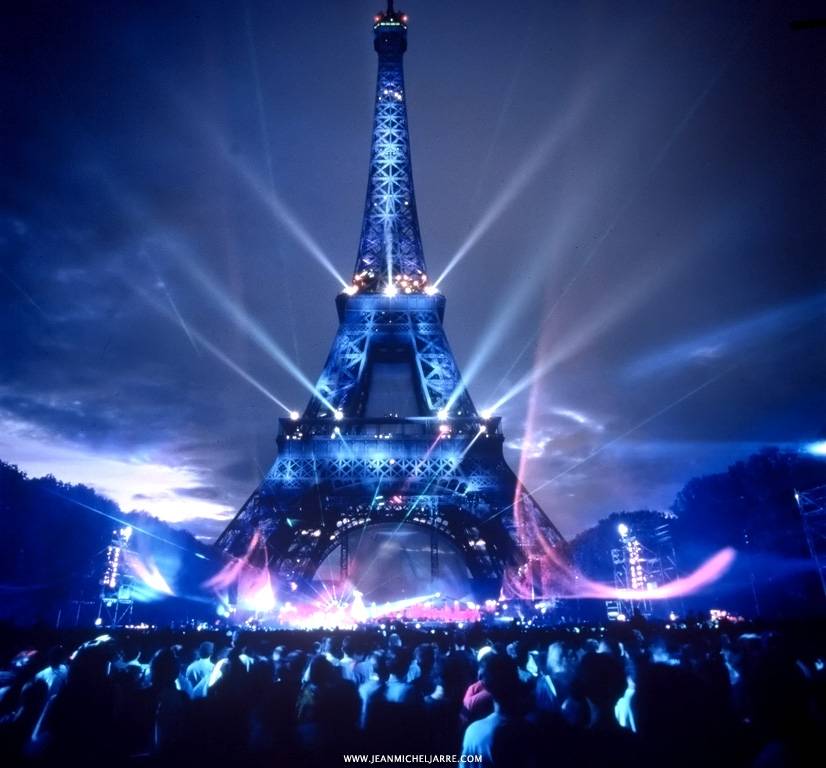
In 1995, Jarre’s status was further solidified with the prestigious French Legion of Honour award. His legendary reputation was further highlighted by a massive outdoor event he staged at the Eiffel Tower. The ‘Concert Pour la Tolerance’ marked the 50th anniversary of the United Nations, again attracting an audience of over a million people. Additionally, Jarre lit the Eiffel Tower so spectacularly that it inspired the French government to install permanent lighting at the site, a feature that remains to this day.
Jarre’s fascination with remixing and the evolution of EDM began to exert a stronger influence on his work in the coming years. He garnered admiration from EDM fans and artists alike, being dubbed the “Godfather of Techno,” a title that provoked mixed reactions. Techno, like most electronic music genres, evolved from various influences rather than a single source, but the rhythmic touchstones present in tracks like ‘Oxygene (Part 2)’ and ‘Magnetic Fields (Part 1)’, along with the swift harmonics of ‘Oxygene (Part 5),’ significantly shaped the genre and inspired a generation of electronic musicians. Jarre’s clear enthusiasm for the genre further solidified this title.
During this period, Jarre signed a new contract with Sony Records, transferring his back catalogue from Polydor. The albums were remastered and reissued by Sony in 1997; these editions, now out of print, are superior to earlier CD releases and are highly sought after.
Jarre’s eleventh studio album, ‘Oxygène 7-13’, was released in May 1997. As with any return to an earlier triumph, reactions varied. The new album combined the classic sound of Jarre’s initial success with modern EDM influences, leading to polarized opinions. Fans either embraced it or viewed it as misguided nostalgia with unwelcome tweaks. However, time has been kind to the record, which showcases a blend of Jarre’s signature warmth and melody with the vibrant energy of contemporary EDM. Opening with the expansive ‘Oxygène (Part 7),’ the album soon introduces modern elements. The trance-like ‘Part 8’ and frenetic ‘Part 11’ present a stark contrast to Jarre’s typical sound yet remain quintessentially his, merging the Gallic romanticism of their creator with his adventurous spirit.
Jarre launched another tour in support of Oxygène 7-13, this time tailored for indoor venues. While more modest than the ‘Europe In Concert’ tour, it still dazzled with 37 concerts over six months, visiting countries where Jarre had not previously performed. The setlist heavily featured tracks from both Oxygène albums, allowing him to play some original material after quite a long hiatus—a special treat for fans. The tour culminated in a massive outdoor concert in Moscow, breaking the record for outdoor attendance yet again, with a staggering 3.5 million people gathering in the streets.
Given Jarre’s enthusiasm for EDM and the interest from EDM artists, collaborations were unavoidable. Over the next two years, Jarre increasingly focused on this genre. Most notably, he staged another performance on Bastille Day in Paris, dubbed “Nuit Electronique,” where he shared the stage with numerous EDM artists and showcased an EDM-influenced set that perfectly matched the celebratory spirit following France’s World Cup victory.
In the same year, Jarre made a guest appearance at the Apple Expo with a small band, performing material from both Oxygène 7-13 and Odyssey Through O2, along with classic tracks. This approach raised eyebrows among some purist fans, who viewed Jarre’s genuine interest in EDM as a mid-life crisis and considered his ventures into a genre they deemed beneath him to be misguided. What these fans overlooked was that this development was a logical extension of Jarre’s insatiable curiosity and passion for new technology, which initially drew him to electronic music.
It would be hard to envision a more fitting way for the decade to conclude for Jarre. On New Year’s Eve 1999, he staged a millennium concert in Egypt, at the Gizan plateau beneath the Great Pyramid. This venue had long been a dream for Jarre, and the performance allowed him to preview many tracks from his forthcoming twelfth studio album, Metamorphoses. Yet, it did not unfold as triumphantly as he had hoped. As the final hours of 1999 approached, temperatures on the plateau dropped, forcing Jarre—which was compounded by a cold he had been nursing—along with his musicians to bundle up warmly. Dense fog rolled in, obscuring Jarre’s planned pyramid projections, leading to their cancellation. Additionally, he had to alter some of his material to satisfy the Egyptian government: ‘Revolutions’ had to be renamed ‘Evolution,’ as the use of the term “revolution” was prohibited; also, references to “sex” were erased from lyrics. Furthermore, mid-performance, a piece was omitted to ensure the countdown to the New Year was on cue. All in all, while it may not have been the dream concert Jarre envisioned, it nonetheless allowed him to check it off his bucket list.
Next time: In the fourth and final part: ‘Metamorphoses’ proves controversial, Jarre’s series of “secret” albums, an unexpected “mistake,” and a revival in his career…
Fuente original: echoesanddust.com
Publicado originalmente el 2017-01-11 03:01:00 por
Hashtags sugeridos: #Echoes #Dust #Guide #JeanMichel #Jarre #Part