
After six decades, Jean-Michel Jarre continues to shape the future of electronic music. Since 1972, he has been a beacon of innovation, with his monumental third album, Oxygène, selling 18 million copies and igniting the synth movement of the 1970s.
From the advent of modular synthesizers to advancements in digital recording—and now artificial intelligence—Jarre’s passion for technology remains strong, seamlessly connecting the avant-garde with mainstream appeal through groundbreaking albums and performances.
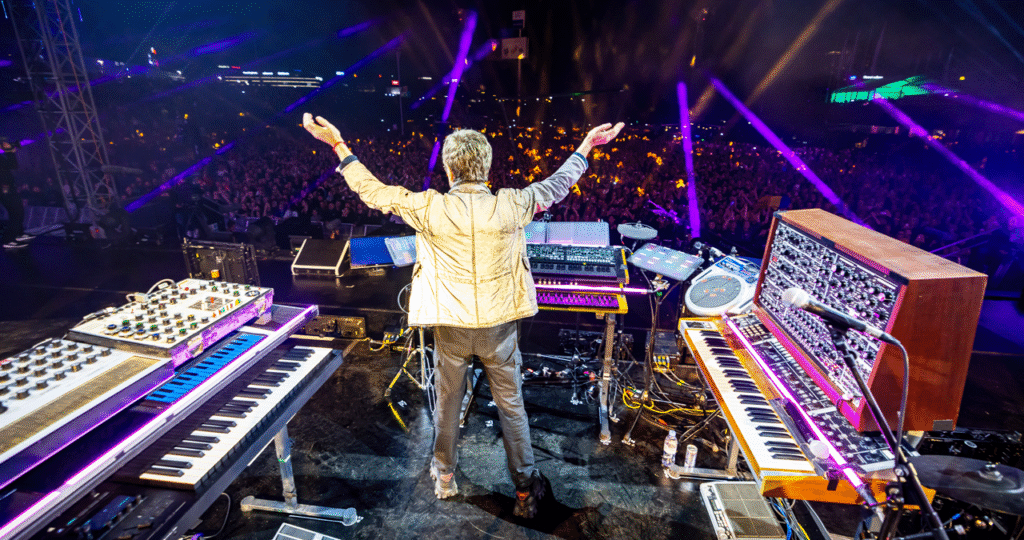
This month, the ever-evolving artist launches Live in Bratislava, showcasing his breathtaking open-air concert Bridge from the Future, held in Slovakia in May 2024. Attracting over 100,000 fans along the Danube’s shores, with millions more tuning in globally, it has been hailed as Jarre’s most ambitious live show yet.
You may like
The event transformed Bratislava’s UFO Bridge into a futuristic venue adorned with dual 30-meter towers, lasers, fireworks, a mesmerizing 400-drone ballet, and state-of-the-art visual storytelling. Additionally, the concert featured a historic collaboration with Queen guitarist Sir Brian May, alongside the Slovak Philharmonic Orchestra and Choir.
MusicRadar: What circumstances prompted you to deliver such a spectacular one-off live performance in Bratislava in 2024?
Jean-Michel Jarre: “It stemmed from a collaboration I’ve maintained for several years with an organization called Starmus, founded by Stephen Hawking. We’re currently supported by astrophysicist Dr. Garik Israelian and Brian May, known not only as a musician but also as an astrophysicist.
“We envisioned creating a remarkable launch for this annual assembly of scientists, musicians, and entrepreneurs from around the globe, aiming to reflect on society and promote values connected to science, art, and culture. Technology and science have been integral to my artistic journey, so participating in such a project felt natural.”
Jean-Michel Jarre – STARMUS – BRIDGE FROM THE FUTURE – LIVE FROM BRATISLAVA – YouTube
Watch On
MR: You’ve performed some major shows in the past; how would you say Bratislava stands out as your most ambitious?
JMJ: “When I began my career, Italian filmmaker Federico Fellini shared something profound with me. He said, ‘Whenever I made a movie, I always felt it was completely different from the last, yet in hindsight, I see I made the same film.’
“He was pointing out that whether you’re Tarantino or Kubrick, filmmakers are consistently telling their stories, with each film reflecting their unique style.
«As artists, we’re drawn to refining our craft, and I’ve always been passionate about performing electronic music that incorporates stage design and visual elements. I was among the pioneers in projecting visuals onto buildings and have revived this expression because it remains interesting to explore how I can stretch the limits of modern technology.
“In recent years, I’ve engaged significantly with AI from a visual standpoint, utilizing it to design the stage for this project. With AI, we can achieve what would have been inconceivable a mere 10 or 15 years ago, and Bratislava exemplified that, featuring numerous talented visual technicians working with AI, lasers, and video.”
MR: The concert is titled Bridge from the Future. How does this theme connect to the visual storytelling and choreography?
JMJ: “Initially, our goal was to create a performance linked to the launch of the Starmus festival—the first installment focused on Stephen Hawking and our relationship with space, while this second part aimed to flip that concept.
“While we don’t know what the future holds, our dreams and abstract concepts might well represent tomorrow’s reality. Through art, music, and science, I aspire to form a bridge connecting the future to our present, using elements we believe will come to fruition.”
(Image credit: Tomas Kika/Jean-Michel Jarre)
MR: You’re known for solo performances, but this time you had other musicians with you. Is this to lessen your dependence on technology?
JMJ: “I frequently alternate between playing with a band and working within an electronic framework using backing sequences, sometimes blending both. Given the scale of the staging and the fact we were in the heart of Bratislava, a bustling city, I felt it was beneficial to invite musicians like Brian May and form a band. This included not only drums, synthesizers, and guitars, but also orchestral components like choir and trombone for a grand effect.
MR: What influenced your decision to use the GRP A4 modular synthesizer as your primary keyboard for the show?
JMJ: “At the core, we’re analog beings in a digital realm, so I relish combining vintage analog equipment with digital technology. While the violin is significantly older, we don’t refer to it as ‘old’ since it’s an ageless instrument.
“For me, the Moog Modular and the Italian GRP are exceptional and timeless instruments, and it’s fascinating to blend them with AI tools or pure digital interfaces. That’s the essence of today—sometimes you drive an electric car, other times you ride a bike. As a musician, I enjoy navigating these contrasts.”
MR: We also noticed you utilized an EMS VCS 3 on stage. Was that to faithfully recreate sounds from your earlier recordings?
JMJ: “Absolutely, but there’s also a fetishist element involved; using it live has become almost ritualistic for me. The VCS 3 is my first synthesizer, which has made me superstitious—I want it to be part of everything I do. It also allows for unique sound effects during transitions, enriching my color palette.”
MR: What other technologies played a critical role in your live performance?
JMJ: “I frequently use a new French digital interface called the Embodme Erae Touch. Shaped like an iPad but slightly larger and thicker, it’s a tactile controller that responds to X, Y, and Z touch data, enhancing the velocity and offering a wider range of playing options.
“I have several Eraes controlling various elements like volume and sound effects, and it can also trigger sequences, making it integral to my gear setup.”
(Image credit: Tomas Kika/Jean-Michel Jarre)
MR: What’s the circular device you occasionally tapped?
JMJ: “That’s a Roland HandSonic, an electronic percussion instrument capable of triggering up to 16 different sounds per song, switching tracks via MIDI control. Most of the time, I stick to the 16 sounds programmed for the show, allowing for a drummer-like experience.”
MR: If we consider a classic Jarre track like Oxygene 2, do you remodel it to keep things fresh for both yourself and the audience?
JMJ: “That’s an intriguing question. Next year, I’m embarking on a world tour, visiting the UK, France, and the US. Recently, I did a series of shows where we altered a track like Oxygene 2 for each venue.
“In Bratislava, I thought it would be interesting to create an extended intro for Oxygene 2, collaborating with young British performer, composer, and producer Adiescar Chase. We produced a sort of duet where I played an electronic flute alongside her electric violin, retaining the song’s structure but varying elements to keep it exciting.”
MR: Brian May’s performance was remarkable. Did you rehearse together, or is he able to improvise effortlessly?
JMJ: “We rehearsed extensively before the concert. He’s undoubtedly an exceptional musician and also a brilliant scientist and human being. We discussed his role a lot; from the outset, Brian acknowledged it was my show and aimed to fit into my vision, which was a challenge considering the electronic arrangements he had to integrate with, quite different from the full control he has with Queen.
“In the end, the outcome was fantastic, and we really connected, even with the many technical hurdles. Electronic music typically utilizes ear monitors, which allow for greater precision, but as a traditional rock guitarist, Brian prefers wedges. Managing a stage cluttered with amplifiers and wedges was quite a challenge (laughs), but we adapted to very different monitoring methods, ultimately creating something quite unique for the audience.”
(Image credit: Tomas Kika/Jean-Michel Jarre)
MR: Are there other artists you’d like to collaborate with live?
JMJ: “It mainly depends on their availability. I was truly impressed by my collaboration with Pete Townshend a few years back for my Electronica project. He represents an artist who has made impactful contributions to music history while being aware of technological advancements, and I would be thrilled to work with him again.”
MR: What technical challenges arose during a concert of this size and scale?
JMJ: “Being an outdoor event, we had to contend with variables like rain and wind, set up live miking for the acoustic instruments and choir, manage amplification for the electric guitars, and maintain direct outputs from the electronic keyboards, which presented numerous technical obstacles. Additionally, we were filming the performance, raising issues surrounding time coding, radio frequencies, and transmission.”
MR: With all the fireworks as well…
JMJ: “Exactly, and we also integrated drones as part of the stage design—not merely as decoration, but as synchronized elements responding to the music’s rhythm. I collaborated with an extraordinary company named KVANT, based in Bratislava, for laser projections, which further showcased the local talent in bringing our vision to life.”
(Image credit: Mark Gidley/Jean-Michel Jarre)
MR: You also featured video from Edward Snowden for the track Exit, exploring themes around privacy and digital information storage. With AI’s rise, does that heighten your concerns?
JMJ: “The collaboration with Edward arose because I admire his bravery and view him as a modern hero. He resonates with my mother, a prominent figure in the French Resistance, who instilled in me the importance of standing against regimes or ideologies that could threaten our community.
“Edward shares a passion for electronic music, so I visited him in Moscow to discuss, record, and film for this piece. He proposed the title Exit for obvious reasons, and I felt it was significant to perform this track in Bratislava, addressing the relationship between modern technology and its impact on our lives.”
Jean-Michel Jarre, Edward Snowden – Exit – YouTube
Watch On
MR: Some years back, you discussed developing AI-driven algorithmic software with Sony CSL. Did that collaboration lead anywhere?
JMJ: “I maintain contact with Sony CSL, but there remains much work to be done regarding AI and music, particularly around copyright and authors’ rights. It’s understandable why the industry perceives AI, or algorithmic use, as a potential threat, yet reducing the discussion to a singular legal perspective would be misguided.
“We need appropriate guidelines as the current system risks appropriating our content, relying on algorithms that would otherwise have to source from a dictionary. Thus, the worth of these corporations hinges solely on our contributions.”
MR: Can you envision a system that fosters a more equitable relationship between musicians and those profiting from harvested content?
JMJ: “I believe the traditional copyright and authorship frameworks don’t suit the new dynamics we will face with AI. Artists and the creative community deserve their fair share of the digital landscape.
«We are commercial allies and ought to cease pleading for rights or a royalty framework that doesn’t align with algorithmic logic. Current AI algorithms lack comprehension of what they harvest.
“These young developers are passionate about music and cinema, and are not against artists; however, to broker deals, we must communicate in a shared language. Instead of allowing the false libertarian perspective that regulations stifle freedom, we should establish rules to facilitate safety, similar to how driving licenses enable safe road travel. Nonetheless, AI is a remarkable tool—I now prefer the term ‘augmented imagination’ over ‘artificial intelligence.’”
MR: Did you face any AI-related copyright complications during your initial engagements with Sony CSL?
JMJ: “When I commenced discussions with Sony CSL, I encountered mathematicians and pure scientists. Initially, I felt disheartened as their understanding lacked crucial music elements like groove and unpredictability. Music composition can’t simply be quantified—it transcends numbers. While I don’t solely implicate Sony CSL, this is still a concern today.
“In my upcoming project, I intend to utilize an iPhone to facilitate dialogue with an algorithm, allowing me to approach it in an intuitive and creative way. Currently, I focus on a visual perspective, but it’s essential to note that I craft the content using AI; it doesn’t generate spontaneously, and I dictate the outcome based on my vision, which is analogous to engaging with a synthesizer.”
(Image credit: Tomas Kika/Jean-Michel Jarre)
MR: In a century, do you foresee an AI-generated Jean-Michel Jarre performing live on stage?
JMJ: “I’m not prepared for cryogenics quite yet, but I understand your question. As humans, we are made of flesh and blood, and while AI presents remarkable possibilities, it ultimately revolves around our existing 12 musical notes. The distinctiveness of artists like Miles Davis, Billie Eilish, or Mozart lies in their individual expression, something that AI cannot replicate.
“AI might glean inspiration from the past and identify styles, but it will certainly give rise to new genres, bepop, rock and roll, techno, and compelling art forms, which is thoroughly exciting.”
Jean-Michel Jarre – Live in Bratislava is available now through Sony Music Entertainment. For additional information, click here..
Fuente original: www.musicradar.com
Publicado originalmente el 2025-09-08 11:25:00 por
Hashtags sugeridos: #analog #animals #living #digital #age #AIdriven #stage #design #collaborating #Brian #speak #electronic #icon #JeanMichel #Jarre