
By: Dave Cooper
Jean-Michel Jarre | Website | Facebook | Twitter
After his spectacular performance on the Gizan plateau in Egypt on New Year’s Eve 1999, Jean-Michel Jarre returned to his musical pursuits. The first item on his agenda was the release of his tenth studio album, Metamorphoses, which would become one of his most divisive works. This album marked a significant shift for Jarre in two notable ways: it veered away from his traditional recording methods and for the first time, integrated vocals extensively.
Metamorphoses exemplified Jarre’s full embrace of digital technology. Since adopting the Fairlight CMI in the early ’80s, he had championed digital recording technology since Zoolook. With this album, he took a more radical step by predominantly using ProTools for the arrangement, editing, and manipulation of his songs. This move revealed a growing divide within his fanbase: some cherished his analogue synthesizers while others prioritized the essence of the music over its creation methods. For the first time, online forums dedicated to Jarre erupted in heated debates, a contention that still persists as fans argue over Jarre’s digital journey.
Even more contentious was the extensive use of vocals in Jarre’s music. While he had previously incorporated vocals—such as Laurie Anderson’s intricate vocal work in his song ‘Diva’ from 1984’s Zoolook—this album took it to a new level with almost every track featuring distinct vocals. Alarmingly for some fans, some of these vocals were his own. Though he had once disguised his singing with a vocoder on the title track of his 1988 album Revolutions, Metamorphoses represented a bold new experiment.
Upon its release in January 2000, Metamorphoses swiftly polarized listeners. It’s unlikely that this divide stemmed solely from Jarre’s use of ProTools, as the album retained its organic sound despite a few evident stutter edits. Rather, some longtime fans felt that the inclusion of vocals detracted from the mystique of his work or harbored doubts about his embrace of contemporary EDM influences, as many tracks bore inspiration from his recent collaborations with EDM artists.
Though divisive upon release, revisiting Metamorphoses today reveals an album rich with freshness and vitality. The fusion of EDM elements with his atmospheric and melodic style is nearly flawless—except in tracks like the syncopated chaos of ‘Bells’. The album showcases a wide variety of sounds, allowing Jarre to highlight numerous guest vocalists. He himself takes the (heavily processed) microphone several times, yet it’s the diverse guest artists who add much of the vibrancy. Laurie Anderson returns for ‘Je Me Souviens’, harmonizing with Jarre; Dierdre Dubois uplifts the haunting ‘Miss Moon’ with her soaring vocals reminiscent of Peter Gabriel’s electronic world music; Sharon Corr (of The Corrs) enriches ‘Rendez-vous à Paris’ with romantic violin; and renowned Egyptian singer Natacha Atlas delivers a stunning performance in ‘C’est La Vie’, the album’s lead single. The inclusion of various guest artists may have confused long-time fans who felt Jarre was compromising his music, but they overlooked his legacy of collaboration and his penchant for musical challenges.
Yet the album was not solely characterized by vocals. It also showcased Jarre’s humor, particularly in the weather-obsessed track ‘Tout est Bleu’, as well as his refusal to be categorized. From driving techno and minimalist piano-led electronica to grand orchestrations and world music—exemplified in the eerie ‘Miss Moon’ with its African-inspired percussion and the reflective conclusion of ‘Silhouette’—Metamorphoses was undeniably daring.
Despite this, commercial success eluded the album. While Jarre had navigated the rise of EDM adeptly, it appeared that the mainstream had ultimately caught up with him. In blending his established style with emerging electronic trends, he found himself no longer standing apart from the broader electronic music landscape, alienating some listeners who were resistant to his newfound openness to change. Whispers of Jarre having “sold out,” and that he had abandoned conceptual music for a ‘pop’ style surfaced. Though much of the album was club-friendly, critics overlooked that some of Jarre’s earlier works had also found their way into clubs during their original releases. Having been in the industry for decades, the now 52-year-old Jarre faced a generational disconnect where younger listeners deemed him unfashionable, while some long-time fans struggled to understand his experimentation with modern styles.
Throughout the remainder of the decade, Jarre continued to create music but in different formats. His next album, Interior Music (2001), was produced for the high-fidelity company Bang & Olufsen, limited to just 1,000 copies. It featured two lengthy ambient pieces, with the first incorporating snippets of promotional messages in several languages. The album served primarily as a demo for Bang & Olufsen stores, yet it was never given a wider release. It seemed Jarre recalled his earlier decision regarding the Music For Supermarkets album, which had become an exhibit in its own right. Consequently, Interior Music remains more of a curiosity than a must-have, with its rare copies fetching high prices on auction sites like eBay.
The subsequent year saw the release of Sessions 2000. Intended to fulfill his contractual obligations with Sony, the album nonetheless offered intriguing insights. Comprised of six improvisations, with titles indicating their recording dates, it notably carried an exploratory feel; the raw nature of the arrangements suggested listeners were experiencing Jarre in the studio, evolving his ideas. The jazz influences are pronounced, particularly in the first two tracks. ‘January 24’ features a warm bass line and late-night piano, while ‘March 23’ showcases a programmed beat interwoven with twinkling synth and sparse trumpet. ‘September 14’ even evokes the sound of the Twin Peaks score, with brushed percussion and atmospheric electric piano. Echoes from Interior Music linger, underscoring how his progress diverged significantly from Metamorphoses.
With his exit from Sony and Francis Dreyfus Music (following disagreements), Jarre produced his first record for Warner Bros in 2003. This album had an unconventional origin—commissioned by Jean-Roche as a soundtrack for his Paris nightclub, the VIP Room. Musically, it developed upon ideas from Sessions 2000, possibly explaining why Jarre chose to finalize that album in its incomplete state.
His new project, Geometry Of Love, adopted a more electronic vibe while retaining the smoky, atmospheric essence of Sessions 2000. Compared to its predecessors, it was significantly more complete in both musical and thematic execution. However, it sparked some controversy due to its cover art, featuring a manipulated image of a female pubis—the model being none other than actress Isabelle Adjani, Jarre’s partner at the time. One track is even titled ‘Near Djaina’, an obvious anagram of ‘Adjani’. This revelation captured media attention, much to Jarre’s dismay, who had hoped to keep his personal life private following his divorce from actress Charlotte Rampling in 2002. Adjani, discontent with the publicity, publicly ended her relationship with Jarre.
Ironically, Jarre’s next album prominently featured his subsequent partner as well. The 2004 release of Aero served as a ‘Best Of’ compilation, entirely re-recorded and presented in surround sound for the first time. Jarre blended straight renditions of select favorite tracks with new and radically reinterpreted older pieces, artfully connecting them with audio interludes designed for the surround sound format. The resulting audio experience, particularly in its native surround sound, was captivating. This album marked a notable commercial success for Jarre after the struggles of Metamorphoses. The surround edition featured a visual companion, showcasing Jarre’s new girlfriend, actress Anne Parillaud (of Nikita fame), whose emotional responses to the music played out visually throughout the 70 minutes of performance. While not essential, it offered a unique and compelling experience.
The launch of Aero prompted Jarre to host more elaborate ‘one-off’ live shows, a format he had returned to after his last tour featuring Oxygène 7-13 materials in 1997/98. In the interim, he performed numerous grand outdoor shows, including notable concerts in Okinawa and at Greece’s Acropolis (both in 2001), and a remarkable wind-powered performance (also titled Aero) in Aalborg, Denmark in 2002. Despite extreme weather conditions turning the venue into a mess, the dedicated 40,000 attendees showcased Jarre’s continued fanbase amid commercial decline. In 2004, with Aero finished, Jarre returned to China, specifically Beijing, where he had played in the early ’80s. This time, he performed outdoors in the Forbidden City—a significant honor for a Western artist, with the show presented in 5.1 surround sound, reflecting the Aero material. True to his provocative nature, Jarre concluded the show at a secondary stage set in Tian-Anmen Square, intending to honor the victims of the infamous 1989 standoff between military and protestors. This act ignited some controversy in the West, but the event, broadcasted live, reached an astonishing audience of over a billion, indicating Jarre’s successful reconnect with fans. This show was soon followed by a grand performance in Gdansk, organized by Lech Walesa to celebrate the 25th anniversary of the Solidarnosc movement. Jarre, sympathetic to the cause, created a genuinely momentous event, highlighted when he invited Walesa on stage to perform the shipyard workers’ hymn ‘Mury’. Both the Chinese and Polish performances were documented and released as combined DVD/CD sets, marking a first for Jarre’s shows specifically designed for DVD audiences.
This era of sporadic yet extravagant live performances culminated in a desert event in Morocco, titled Water For Life, aiming to raise awareness for UNESCO’s cause concerning clean drinking water. Jarre, working as a UNESCO ambassador, orchestrated a spectacular show supported by local talent. However, the nature of recent performances began to stir new controversy.
Over the years, fans noticed that Jarre often performed with significant pre-recorded elements rather than fully live. While this reliance on playback wasn’t new—having existed since his earliest concerts—it became more apparent as Jarre’s recent shows frequently featured only a small number of live musicians alongside backing tracks. Some fans felt deceived, arguing that the essence of a live performance should inherently involve actual performance. In Jarre’s defense, numerous factors prompted the use of playback; early on, his analogue synthesizers were notoriously sensitive and prone to tuning issues. Over time, unpredictable weather, equipment backups, and the expectations of a global audience for live broadcasts increased the necessity for a safety net. Stung by accusations questioning his live performance capabilities, Jarre began planning a tour unlike any he had previously initiated—setting the stage for perhaps his most significant controversy yet.
In March 2007, Jarre released Téo & Téa, a collaborative effort with Tim Hüfken, presenting Jarre’s most commercial album to date. Moving away from his traditional textures, it heavily rooted itself in EDM and club culture, inviting harsh criticism from fans. Ironically, it received favorable reviews from critics, revealing the widening gap between long-standing fans and the mainstream EDM crowd. Some conservative fans speculated that Téo & Téa was crafted under Hüfken’s oversight, produced to cater to a broader audience. Speculation intensified when it became known that various tracks used presets from the new Roland MC808 synthesizer—an instrument Hüfken had helped develop. In response, Jarre’s management clarified that he had been involved in creating the MC808 presets and that the album was significantly influenced by this process. Hüfken dismissed the conspiracy theories, explaining that Jarre had been clear from the start about wanting a more mainstream sound, and that he had actually tempered some of Jarre’s more avant-garde ideas.
Téo & Téa stands as an outlier in Jarre’s catalog. Unapologetically commercial, it often receives lackluster responses from long-time fans; yet melodically, it retains Jarre’s signature touch—from the ‘Erosmachine’-referencing ‘Beautiful Agony’ (with Parillaud echoing the orgasmic female vocals from an earlier track), to the Speak-And-Spell machine vocals of ‘Touch To Remember’, and the classic Jarre-styled anthem ‘Vintage’ to the Magnetic Fields-like semi-improvised feel of ‘Melancholic Rodeo’. The album’s EDM-influenced tracks like the opener ‘Fresh News’ and the title track demonstrated a new direction that some fans found to be the stumbling block. It illustrated once again how electronic music can be just as factional and style-driven as rock or folk genres. Although Téo & Téa has aged gracefully, initial fan reactions were predominantly negative. Hurt by the backlash, Jarre later remarked in an interview that the album was “a mistake”—a rare admission from an artist known for his willingness to experiment and a reflection of how deeply he felt the criticism towards the album.
Thus, Jarre felt the need to regain his artistic identity. His solution? To revisit the core of his success. He re-recorded and re-released Oxygène, complete with a DVD showcasing a live performance of the album and additional interludes—an endeavor entirely with vintage instruments. He then took this show on the road, which helped to restore his connection with conservative fans he had begun to alienate. The tour—evidently live, complete with the quirks of older equipment—was a significant success, reaffirming Jarre’s position as a pioneering figure in electronic music.
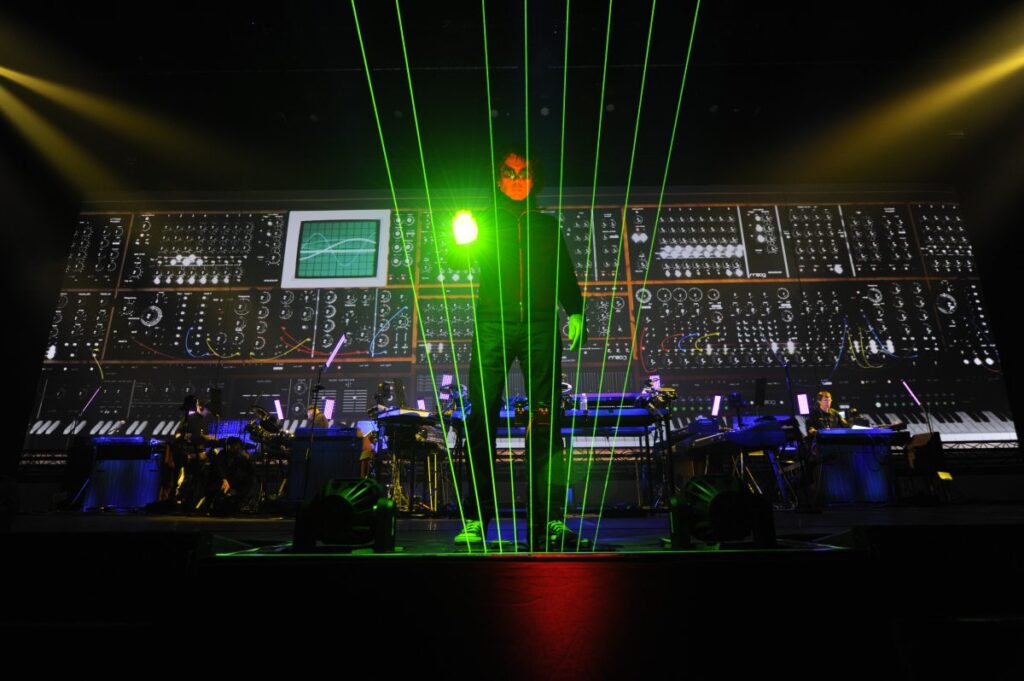
The updated edition of Oxygène was Jarre’s last commercial release until 2015; however, he remained active in the meantime, touring nearly constantly: initially with the Oxygène show and later with the In-Doors and 2010 tours, highlighting his classic works from 1976 to 1993. These performances were much more authentically ‘live’ than before, featuring Jarre and a small band utilizing both vintage and modern synthesizers, plus the iconic laser harp. The 2010 tour concluded spectacularly with an open-air concert in Monaco in 2011, celebrating the marriage of Prince Albert II. Broadcast live (mistakes included) to millions worldwide, this event felt like a gratifying culmination of Jarre’s celebration of his long-established catalog. Notably, it featured ‘Vintage’ from Téo & Téa, reinforcing that Jarre still had points to make regarding one of his least favored albums.
Which brings us to the present and Jarre’s recent projects, the two volumes of his Electronica series. Designed as a grand collaborative venture, highlighting the diverse elements of electronic music, the Electronica albums have garnered both critical acclaim and creative success. A love letter from Jarre to the music that inspired his journey, they celebrate the broader electronic music landscape; over five years, this dedication encapsulates Jarre’s artistic range. Typically, these albums have stirred differing opinions among fans: a familiar divide persists between those longing for a return to his Oxygène roots and others pleased with Jarre’s willingness to explore. Later this year, Jarre will return to the stage to present his latest work; while it’s impossible to foresee what he has planned, experience has taught Jarre’s fans to relinquish their expectations and embrace the anticipation of new creations.
In an era of genre-blending musical styles, it’s fitting that France’s original enfant terrible continues to produce challenging music that invites listeners to cast aside preconceived notions while still weaving together atmospheric elements, melody, and a playful spirit. Such compositions elicit emotional responses that detractors of electronic music often claim are unattainable. Jarre’s bold vision in both composition and live performance has profoundly influenced countless musicians. Today, at 67 years old, he stands as a monumental figure in the electronic music world, a respected influence across an array of artists, as demonstrated by the impressive list of collaborators in the Electronica project. Jean-Michel Jarre was, is, and will forever remain a singular presence in the history of electronic music.
Fuente original: echoesanddust.com
Publicado originalmente el 2017-01-11 03:01:00 por
Hashtags sugeridos: #Echoes #Dust #Guide #JeanMichel #Jarre #Part