
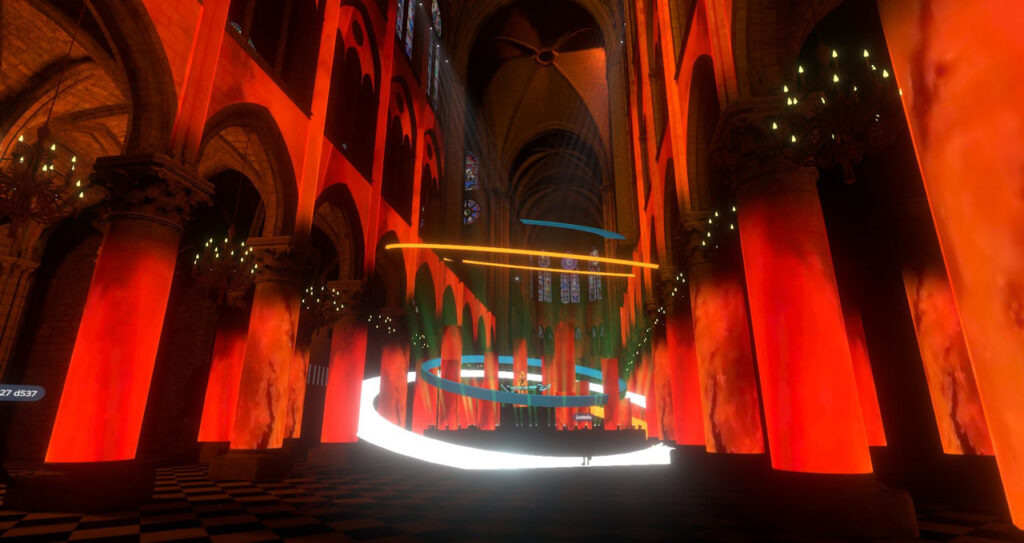
This New Year’s Eve, along with the team from VRrOOm, I had the opportunity to be part of the virtual reality concert Welcome To The Other Side, featuring the iconic electronic music legend Jean-Michel Jarre performing within a virtual Notre-Dame Cathedral. The concert achieved fantastic success (with over 75 million total views!), made possible through the extraordinary efforts of the talented professionals involved. After numerous requests from community members for a postmortem detailing the lessons learned and sharing some anecdotes, I’m ready to present a comprehensive overview of my experience during this adventure!
Welcome To The Other Side
The full livestream of the concert
The concept for Welcome To The Other Side originated after our previous concert, Alone Together, also featuring Jean-Michel Jarre. As noted in my earlier postmortem, the concert turned out well, but due to the rushed timeline of only 3 weeks, it faced its share of challenges. Louis Cacciuttolo, the head of VRrOOm, discussed with Jarre the possibility of orchestrating a new concert, this time with ample time for refinement. Jarre, a true innovator, eagerly agreed, and brainstorming commenced on how to create this new virtual event that would highlight the capabilities of VR concerts and fulfill Jarre’s vision.
Numerous ideas circulated for the concert, assessing various target languages, platforms, and event days; however, two consistent elements remained throughout all drafts: Jean-Michel Jarre and Notre-Dame. There was a strong vision of merging these two French masterpieces—so distinct (Jarre as a modern artist, and Notre-Dame as an ancient treasure) yet equally capable of evoking awe—and offering people a chance to experience Notre-Dame once more for a special event. Ultimately, a New Year’s Eve celebration was decided upon, which enhanced its significance and catered primarily to the European audience. Thus, our journey began.
We commenced work in September, ramping up in October. While 3 months is considerably better than the 3 weeks allotted for Alone Together, it still felt inadequate for a production of this magnitude. When Jvan Morandi, who managed lighting choreography and various other aspects, learned about the concert, he remarked, “Is it for Summer 2021, right?” Upon discovering it was intended for late 2020, his response was “You guys are absolutely insane.” Indeed, we are.
How we did it
The first trailer of the concert
If you’re reading my blog, then you’re likely interested in some technical insights into how we executed this project. And I’m delighted to share.
Having more time compared to Alone Together allowed us to enter a comprehensive design phase. During this time, Jarre and the other artists (Vincent Masson, Jvan Morandi, etc.) defined the visual framework of the concert. Various experiments were conducted, ultimately clarifying our end goals.
Once our objectives were established, we launched experiments to determine what could be realistically achieved within VRChat. We opted for VRChat as our platform due to our familiarity and confidence in its capabilities (having executed all our significant projects there), additionally, it’s among the most robust and adaptable platforms available, allowing us to utilize Unity, a game engine we were well-versed in. Furthermore, the vibrant VRChat community had created numerous tools beneficial to our endeavors.
We began assembling the scene in Unity. Many have asked where we sourced that stunning Notre-Dame Cathedral model. While I would love to say we crafted it ourselves, the truth is it was the model used by Ubisoft in Assassin’s Creed, which took 2 years to develop. Following the cathedral’s fire, Ubisoft generously made the model available for artistic projects, making it a perfect fit for ours. Originally, I mentioned acquiring it from Ubisoft, but we ultimately decided to use a different model we discovered online for ease of management. The model was optimized for VRChat by MID, after which we populating it with concert elements.
A beautiful picture of a virtual Notre-Dame (Image by VRrOOm)
Vincent Masson produced the breathtaking 3D animations you experienced, while Jvan Morandi managed the spotlight choreography and collaborated on the 2D videomapping projected onto the cathedral walls. SoWhen was responsible for crafting a captivating avatar of Jean-Michel Jarre: a challenging task as the artist’s public persona is essential, needing to be both appealing and reflective of JMJ’s style. Utilizing Unity, we resorted to standard asset types for all features: FBX models for 3D animations, avatars, and spotlights; light objects for spotlight illumination; and mp4 videos for videomapping, projected with appropriate UVs on the cathedral walls. For tracking Jean-Michel’s movements, while Vive Trackers were used previously due to their reliability, for WTTOS (Welcome To The Other Side), SoWhen incorporated a mocap suit compatible with SteamVR, ensuring enhanced accuracy in tracking the artist’s movements, complemented by tracking gloves to capture his gestures while playing instruments.
Here you can see Freddy Konè from SoWhen helping Jean-Michel put on the tracking suit.
After gathering all the materials, it was time to integrate everything into Unity and optimize the experience. The majority of this work fell to Lapo Germasi and Victor Pukhov from Manifattura Italiana Design (MID). VRChat imposes certain demands on smooth framerate (no one wants to experience a concert at 20 FPS), and also on scene weight: exceeding 300 MB can affect download times and, in some cases, lead to crashes, spoiling user experiences. MID and I ensured optimal performance and minimized download sizes.
Subsequently, MID and I finalized by adding:
- All timing mechanisms: from spotlight cues to videomapping, every element had to sync perfectly with the music, necessitating creative solutions within VRChat;
- All interactions: we couldn’t create a VRChat world absent of interactions. Interactions enhance user engagement and justify the VR experience, so we implemented features allowing audience interaction during the concert (such as making the simulated crowd burst into colorful stars);
- All necessary components for filming the video. Since the concert took place within VRChat, we did not want to offer a flat stream from a singular viewpoint; instead, we developed a complex camera system in VRChat to enable Georgy Molodotsov and Maud Clavier to create an outstanding 2D version of the concert. We employed an open-source project to set up the camera system, alongside VRCLens for hand-held shots with depth effects, and a 360 video recorder avatar from VoxelKei for capturing the 360-degree videos shown in the Afterparty world. The result is the video embedded at the start of this post.
For the after-party, Denis Semionov designed the experience and also hand-sculpted the entire setting within Quill. MID optimized it, after which we added interactions (like stepping aboard the Zeppelin), and it was ready.
The various types of concerts
A scene from the public rooms of the previous concert Alone Together: that bright light source on stage is the screen featuring the 2D hologram of Jean-Michel Jarre. This was not the experience we aimed for; we desired much more. For this concert, we rectified it.
Reflecting on Alone Together, I must confess that the actual Jean-Michel Jarre was only present in one room, and here I have to convey the same reality. Within VRChat, a person can inhabit a single world instance, essentially a room with 40-60 participants, and there is no workaround for this limitation. While the real Jean-Michel performed live at midnight in Studio Gabriel, Paris, only a handful of individuals were physically present with him. All other attendees experienced mere replicas of his performance.
I acknowledge that this truth may disappoint some, but due to platform constraints, we faced a choice: either host a concert for 40, or cater to a larger audience where only 40 could be in the same room as the artist. Aiming to share this extraordinary moment with as many individuals as possible, we naturally opted for the latter. Once VR platforms can accommodate 10,000 participants in a single instance, we will eagerly provide live performances for all simultaneously, though achieving this may be years away.
Previously, under the “VIP” model, we offered a remarkable experience to a select few while providing a subpar experience to many others, and this time we were determined to change that: we aimed for uniformity in experience across the board, allowing everyone to relish the concert’s grandeur. Thus, despite creating three different types of PC rooms, the experiences remained quite comparable.
The experience for users on PC: Jean-Michel Jarre in Notre-Dame, surrounded by captivating visual effects
The PC rooms were structured as follows:
- The official room, designated for recording and streaming the concert. This room’s uniqueness stemmed from hosting the real Jean-Michel live with the highest level of visual performance (ensuring top-notch quality for the 2D video). Everything synchronized beautifully for everyone present, without concern for framerate or scene weight, as participants certainly possessed high-performing PCs. This room featured the intricate camera system for YouTube content and augmented the “fake crowd” to create the illusion of a fuller cathedral in the videos;
- Several VIP rooms. Nearly identical to the official room, but with an avatar that wasn’t the real Jean-Michel and slightly diminished visual performance to ensure better framerates for visitors. Synchronization was preserved for all as the midnight moment aligned with the actual midnight;
- The public worlds. Nearly identical to the VIP rooms, with the sole difference that their experience was not synchronized with others, including the midnight moment. Here, the performance was pre-recorded and functioned similarly to a music box: at any moment, attendees could hop into the public VRChat world, hit “Start concert,” and witness the concert unfold from the first note, regardless of when they activated it. This method effectively sidestepped the synchronization challenges we experienced with Alone Together, yielding excellent results.
I can assure you that the experiences across all room types were strikingly comparable, and we took immense satisfaction in democratizing this virtual reality concert, making it freely accessible to all across platforms. I’m also pleased to announce that this time, the experience was flawless for all participants, with no complaints regarding concerts failing to display.
A free VR concert ensuring an equitable experience for all attendees
As for the Quest version, replicating the same experience was impossible. The Quest’s hardware limitations coupled with VRChat’s inadequate performance on mobile necessitated the difficult choice to significantly scale down the Quest experience. At one point, we even considered forgoing the Quest entirely, but Louis Cacciuttolo firmly suggested that given the Quest’s popularity, we should provide something for Quest users. We all concurred, though ultimately our best alternative was creating a lounge where users could enjoy a concert video together, akin to an interactive version of Oculus Venues. Denis produced a simplified rendition of Notre-Dame in Quill, allowing individuals to gather and watch the video collaboratively. While the concept was appealing, the execution was subpar.
The mediocre experience on Quest
The curved screen showcasing the concert video on Quest. The experience had the potential to be much better.
The concert achieved resounding success, leaving the team elated. Yet, I’m left feeling unsatisfied because I continually blame myself for the Quest experience.
The focus for this concert was predominantly on the PC version and its streaming capabilities. The PC version (both VR and Desktop) assured the authentic experience we collectively sought to deliver, featuring Notre-Dame, Jean-Michel, and all other elements, so we devoted substantial attention to it, which somewhat detracted from the other experiences, specifically the Quest version and the afterparty (which was cross-platform). While prioritizing the main attraction was sensible as the most essential aspects deserve the most attention, we struggled to ensure that all experiences were of high quality, and this left me feeling frustrated. As the team’s primary VR advocate, I should have paid more attention to the Quest worlds, especially since I recognize that Quest 2 introduced many users to VR.
I received feedback regarding these experiences. Charlie Fink, a VR journalist I highly respect, privately informed me that the Quest experience felt “janky,” while Anne McKinnon criticized the afterparty on VRScout for being merely filled with videos that became dull over time. I was not alone in receiving such feedback, and it stings to acknowledge their points. The Quest experience fell short because it ultimately consisted of a screen displaying a concert recording within a stylized Notre-Dame, and while the Afterparty was visually appealing (Denis did a fantastic job crafting the Cathedral and the surrounding plaza in Quill), it lacked excitement, with limited engaging activities beyond watching concert highlight videos.
The charming Zeppelin soaring above the afterparty environment. I adored its aesthetics but recognized it could have been more functional.
Moving forward: if you offer something, ensure that it meets a high standard and is polished, or it’s better not to present it at all. Perhaps it would have been wiser to abstain from creating an after-party world and concentrate all efforts on crafting a polished concert experience for Quest. In hindsight, we lacked sufficient time to develop a simplified 3D version of the concert suitable for Quest (as Notre-Dame was too intricate), so we resorted to delivering a 2D video, but we should have incorporated more interactive features, such as chairs or portals leading to videos featuring behind-the-scenes content or artist interviews. We should have aimed for an experience distinct from the PC presentation yet still remarkable. Instead, we produced a less impressive version of Oculus Venues. My apologies, Quest users; I promise the next experience will be better.
The importance of VR
VR is extraordinary; long live VR!
If anything from this concert fills me with pride, it is my insistence on making it a virtual reality experience. During the design phase, JMJ and several others questioned whether it would be safer to produce just a 2D version due to the constraints of our timeline. I vehemently opposed this notion and, after conversing with the team, we collectively agreed that if this was a “VR concert,” it should genuinely exist in VR, reassuring Jarre that we could achieve it within the limited timeframe given. He was supportive and placed his trust in us, which turned out to be the best decision; we made history by executing a massive concert entirely in virtual reality for both in-world and out-of-world spectators. Achieving something extraordinary necessitates the willingness to embrace risk.
I’m also pleased to share that everyone remarked it was the ultimate way to experience the concert. Since I was working on New Year’s Eve, my family occasionally came to my workspace to support me and bring me meals. They watched the YouTube livestream, and when they peered at my computer screen, they remarked, “It’s so much better on PC!” Although I wasn’t in VR, their observation was validated: the virtual experience felt more immersive, interactive, and genuine. Many echoed this sentiment: it truly was MORE gratifying in 3D.
In VRChat, attendees could navigate the Cathedral and experience the concert from the first floor above! (Image by VRScout)
Don’t get me wrong: the video produced by Georgy and Maud was stunning, but it was… just a video. The interactive reality, even viewed on a screen, allowed individuals to genuinely feel as though they were within Notre-Dame, contributing to a significantly more immersive experience. Anyone offering a concert labeled as a “VR concert” but ultimately providing a video should take note. I believe that WTTOS was significant because it allowed countless individuals to experience the sensation of truly being within Notre-Dame while enjoying a magnificent concert for the New Year’s Eve.
The problems of New Year’s Eve
It was New Year’s Eve, and we faced competition from VRChat’s official party. That posed some challenges. (Image by VRScout)
Hosting a VR concert on New Year’s Eve is exhilarating: it helps foster a sense of unity among many people globally, celebrating together. Nevertheless, many unforeseen complications arose:
- My New Year’s dinner with family was entirely unceremonious: I scarfed down my meal hurriedly, then rushed to my laptop to troubleshoot the after-party world. My only celebration consisted of going to the living room with 15 seconds until midnight to wish «Happy New Year!» before promptly returning to the concert afterwards. It was heartbreaking not to share the moment with loved ones;
- Many journalists and influencers we engaged were on vacation, causing them to miss our concert;
- Several VIPs we invited indicated they had prior commitments for New Year’s Eve, impacting our event’s visibility;
- Many individuals missed concert announcements and thus didn’t join us in VRChat. I received numerous requests for a replay, and I suggested this to the team… let’s see if we can make it happen;
- VRChat staged its own official year-end event, which overshadowed our concert;
- Most of the VRChat team was on vacation, resulting in limited support leading up to the concert and on the day itself when we encountered significant issues during the final rehearsal. A friend of mine, Chris Madsen, informed me that VRChat servers crashed shortly after the afterparty, so we narrowly avoided a major setback. This represented a substantial risk on our part; perhaps we should have requested VRChat to ensure 24/7 support for the critical final days, including the concert day.
Conversely, numerous advantages emerged, especially in light of the pandemic. As we worked on the concert, a resurgence of COVID-19 struck France, leading to the cancellation of all other in-person New Year’s Eve events. Consequently, this event gained momentum: shifting from merely being a cool, innovative project sponsored by the city of Paris, it evolved into the main New Year’s Eve celebration in Paris and one of the most significant across France. It was broadcast on France TV, received backing from Unesco, numerous sponsorships, featured by the EBU, and even garnered attention from Italian news channels! Accepting newfound responsibilities, we remained confident in delivering quality, and we were delighted by the visibility it brought. It was incredibly fulfilling to witness an Italian news program mention “virtual reality” to a mainstream audience stemming from a project I contributed to.
Italian news program TG5 covered the event. I couldn’t have been prouder to see it! (By the way, follow Cecilia on Twitter; she’s fantastic.)
The missing opportunity on visibility
This project achieved immense visibility across both VR communities and mainstream media. However, while those in VR circles were generally aware of my involvement, the broader media landscape mentioned mostly Jean-Michel Jarre and/or Notre-Dame. Often, only a brief reference was made to VRrOOm, with virtually no acknowledgment of New Technology Walkers, Skarredghost, or other brands I associate with. This was particularly disappointing within Italian media, which often highlight any Italian connection to global events (“the fourth cousin of Biden’s wife is Italian, so Italy won the US elections!”). Thus, it felt a shame that no one acknowledged the significant Italian contributions to this groundbreaking concert (including my own contributions, as well as those from MID Studio and Jvan Morandi). Consequently, I reaped little personal reward from the project’s publicity in Italy.
I believe that next time we undertake such a significant event, we should hire a PR agency to enhance mainstream visibility for both VRrOOm (and its incredible work) and for our individual brands across our respective nations.
The problems of being in a Cathedral
The concert setting was located within Notre-Dame Cathedral, a monument that represents not only artistry but also religious significance. This created challenges regarding what could be incorporated within.
When debating interactions to integrate, we encountered challenges repeatedly. During Alone Together, Jarre suggested we incorporate “magic pills” to trigger whimsical visuals, which resonated with audiences. We knew he would appreciate their inclusion in this event as well… but could we justify incorporating drugs in a church? Certainly not, so these pills evolved into “Magic Glasses” for a visual variation. While we aimed to create a fun element to cause the fake crowd to burst forth, would something violent be appropriate for a church? Consequently, bursts of stars resembling balloons became our solution. As for champagne, we felt it might be offensive…
This was one of the visual effects from the magic glasses, featuring fluorescent blue colors!
While being in Notre-Dame was incredible, it also limited our creativity regarding the showcased elements, necessitating various compromises.
A team working well together
One of my greatest joys is the team that contributed to this project. There isn’t a single team member about whom I can say they performed poorly; everyone excelled, and the remarkable final product is evidence of that.
From Alone Together, we developed familiarity with each other, thus knowing how to collaborate efficiently. There was also a project manager this time (Maud Clavier), who was absent previously, which facilitated improved communication, organized calls more effectively, and set priorities. Although we still experienced some Slack chaos (with people messaging in random channels), overall, the organization significantly exceeded that of Alone Together.
Jvan Morandi, a newcomer, made a terrific addition. Despite his lack of experience in VR, Unity, or VRChat, he swiftly adapted his usual skills in real-world light and visual effects choreography to fit a virtual environment. Witnessing his rapid learning and eventual design of a fantastic light show for the concert was gratifying. His experience illustrates that any artist from physical venues can transition effectively into the realm of virtual events, opening new professional avenues amid the pandemic.
Jvan Morandi is the extraordinary professional responsible for the lighting animations during the concert. (Image by VRScout)
Everyone continually provided support to one another: we collectively sought the best collaborative methods, and once we found our rhythm, progress accelerated.
This collaborative spirit was evident during the concert. We maintained an open Zoom call while the concert aired, allowing us to instantly communicate any issues. This was Georgy Molodotsov’s excellent idea (a remarkable professional with whom I am thrilled to work) and literally saved our team when we discovered we were in the wrong room while VIPs awaited us in another. A brilliant suggestion, which we plan to replicate for future events. The downside was that I was managing only one monitor, operating on the same PC for both VRChat and Zoom. Consequently, I sometimes found myself excitedly yelling “HEEEEEEEEYYYY CHRISSSS WHAAAAASUP, I LOVE YOU!!” to my friend Chris in VRChat, inadvertently sharing my enthusiasm with all Zoom participants, who were likely quite confused. I need to become more adept at managing mute functions across both platforms! 😀
If you are the organizer, don’t do that from VR
Given the discussion about the Zoom call, allow me to share a valuable lesson I learned from previous events:
If you wish to enjoy an event, do so in VR; however, if you aim to manage one, do it via 2D.
While experiencing an event in VR is undoubtedly appealing, managing issues that surface while being immersed can become problematic. Without a headset, it’s easier to address inquiries in chat, troubleshoot online, take necessary phone calls, and switch applications (e.g., from Zoom to VRChat). Plus, you will likely experience less fatigue (wearing a VR headset for extended periods isn’t comfortable), along with the absence of battery-related concerns. Having control from a standard PC proves to be far superior compared to managing everything in VR.
I’ve begun participating in my events through VR, yet since that initial incident with a VR headset during an ENGAGE event, I’ve continuously opted for 2D displays rather than returning to the previous method. Unless moving hands are an absolute necessity, attending on a standard computer is the way to go.
Learning from past errors
The poster for Alone Together, the first concert we organized with JMJ. (Image by VRrOOm)
I firmly believe that the success of this concert stemmed from the numerous mistakes we made during the year across various events. Our learning experiences from prior events, such as Alone Together and Venice VR Expanded, informed our approach to WTTOS. Our achievement was directly tied to our past failures.
In performances at the cutting edge, experience outweighs technical proficiency. Platforms like VRChat are innovative yet fraught with unforeseen challenges. We encountered various obstacles, and necessitated compromises to overcome them. I emphasize this constantly, and I won’t tire of repeating it: performing in VR currently revolves around balancing aspirations with practical limitations. You must always be prepared to devise solutions rapidly to the challenges that will arise, sometimes necessitating the acceptance of suboptimal deliverables yet still adapting to the art of compromise.
A screenshot from the concert. Despite the numerous compromises, it was incredible. (Image by VRrOOm)
For instance, during the after-party, we invested significant time crafting flying umbrellas, granting participants the ability to soar across the plaza. However, due to a bug in VRChat, once you exited the umbrella, you could no longer walk. We spent the final days trying to resolve this, ultimately deciding to eliminate this appealing feature that Victor had painstakingly crafted. Instead, we replaced it with a magic umbrella allowing users to leap high and survey the city from above. It was a difficult decision, but the best course of action for ensuring a successful delivery.
Another instance involved the recording of the concert causing desynchronization issues in the public VRChat worlds. This was a tough choice, but it boiled down to a decision between developing a concert featuring a poorly represented avatar of Jean-Michel or one where half of the attendees wouldn’t even see the experience launch (as was the case previously). Though some might express disappointment, I assure you that replicating this endeavor would present similar challenges: your experience during the process would reveal that we arrived at the best possible compromise. Only with experience can one identify problems and devise suitable solutions.
We also addressed numerous other aspects. We created more VIP rooms and limited attendance within each because previous events demonstrated that excess crowding could lead to severe performance issues. We opted not to rely on VRChat’s “Master User” system since identifying the leading participant is often unpredictable (which ultimately benefitted us in this concert). We prepared various backup plans: for example, Georgy managed his room with two accounts to ensure that one could act as a backup if the other encountered issues, also devising a solution in case both were ejected simultaneously. We executed multiple tests to confirm functionality across the board, even simulating potential real-world conditions.
Should you embark on an event of this nature, perform extensive tests with real users to verify room functionality and prepare for possible system failures. Please, please, please. In Alone Together, we didn’t conduct enough testing within the public rooms, resulting in a dismal experience. Never neglect the testing phase: allocate a minimum of several days to ensure everything is operational before the event.
One critical improvement we made was during the design phase. This time, we allocated more time for design, ensuring everyone understood the intended creation before development began. Prototyping also proved essential to confirm feasibility within VRChat. Furthermore, it was paramount for the artist, JMJ, to experience the event’s look and feel as soon as possible. Until we assembled Notre-Dame with all 3D assets and synchronized videos and lights, even in a rudimentary format, he could not grasp the concert’s essence or determine if it aligned with his vision. I learned that early visualization, even in rough form, is vital: clients deserve to gain insight as soon as feasible to assess their preferences. Prompt feedback provides room for adjustments. In Alone Together, we had insufficient time, leading to many last-minute changes. Please keep this in mind.
This welcoming message was all VIPs encountered upon arriving in the world. Despite its lengthy explanation, most didn’t comprehend their initial responsibilities.
Nonetheless, despite all the enhancements, we still encountered minor errors. For instance, the midnight countdown was not perfectly synchronized with the actual clock due to time miscalculations. We implemented tooltips and messages to elucidate concert features for everyone, but audience members failed to read them consistently. For example, several VIPs found themselves trapped in the initial enclosure. Despite labeling it, “Please wait until we open it. This may take a few minutes,” many assumed they were erroneously confined. Next time, we must simplify instructions. Perhaps we could blend engaging visuals with audio messages to create a more user-friendly experience. Additional lessons learned for future events.
The Parkinson’s Law always hits
If you share my interest in productivity and personal growth, you likely know of Parkinson’s Law. If not, here it is simplified:
Work expands to fill the time available for its completion.
A personal extension of this principle is that “no matter the time allotted, the last 2-3 days will always involve a frantic rush, completing everything at the last minute.” This proved true for our project too. Despite our effective organization, the final week was chaotic. There were countless tweaks, polishings, and fixes. I barely slept on the last day, and stress levels were high. During the Zoom call, I appeared to be losing my mind: on one end, I was exultantly shouting in the VRChat party room, “I’m thrilled for this party! Let’s celebrate!” while on the other hand, I was anxiously querying on Zoom, “F******ck, how’s the upload of the afterparty going?” while Victor screamed incoherently in Russian. Our final updates to the afterparty came late, exacerbated by typical VRChat server upload struggles, and we completed uploading a mere 15 MINUTES prior to going live. Another nail-biting deadline, reminiscent of every project I’ve joined in recent years with all my teams. I’ve come to accept this as a constant theme—a potential “Ghost’s Law.” 😀
The personal problems
On a personal note, I have faced criticism primarily for two reasons: being excessively busy with various tasks and not being communicative enough.
The second point arises from my inclination to favor doing over talking. I’m not fond of calls, hate meetings, and dread emails. “If I’m constantly attending meetings, I can’t accomplish my work,” is a sentiment I express to almost every project manager I work with (and yes, they often despise me for it! :D). I observe that many teams waste time in excessive discussions, with an overwhelming number of meetings ultimately serving little purpose. This tendency risks leaning too far in the opposite direction, wherein I might work too independently, leading to insufficient coordination with team members. Improvement in this area is necessary; however, I will always resist endless Zoom calls! 😀 I suspect project manager Maud Clavier keeps a voodoo doll bearing my likeness in her home, and I can’t entirely fault her! 😀
VR is my passion, and I relish involvement in every aspect of it. Yet, this disposition can sometimes become problematic.
The former issue stems from an underlying truth: I actually take on too many commitments. My active blog, consultancies, and diverse projects keep me busy. I genuinely enjoy all aspects of VR, and when presented with new ventures, my eagerness often prompts me to reply, “YES, LET’S DO THIS!” However, with just 24 hours in each day, reality sinks in when I realize I cannot juggle everything. In recent times, I have improved in managing projects, but it’s worth noting that two significant projects I committed to this year (one being this concert) unexpectedly delivered around the same time. Add to that the turmoil of 2020, during which I faced substantial personal hurdles that consumed considerable time and energy. Essentially, from October onward, I found myself overwhelmed, sleep-deprived, and damaging some personal relationships along the way. Furthermore, as I strive to maintain transparency with those around me regarding my workload, I received complaints from individuals on both projects about my perceived lack of focus. Not the optimal situation to find myself in.
Ultimately, I successfully delivered on both projects but at the cost of immense stress. Personally, this experience was risky and unsustainable, so I advise ensuring you are fully aware of deadlines before accepting substantial projects. Additionally, refrain from over-sharing details about your other engagements. While I enjoy learning about others’ projects and find multi-project involvement normal within professional circles, this view isn’t universally held; when people discover you’re handling multiple tasks, worries about timely delivery arise. Thus, avoid discussions about your other work: just focus on guaranteeing your delivery timelines and proceed with those responsibilities.
An accurate depiction of me managing multiple VR projects simultaneously.
Some have asked how I handle so much concurrent work, and my answer is two-fold: first, intensive work hours combined with strong discipline are essential: when focused, your 3 hours can yield the output of 6 hours from a distracted individual; second, prioritization is key. For instance, during significant projects, I reduced my blog efforts and simplified articles; conversely, I dedicated fewer hours to other projects when strict deadlines loomed. Sometimes, it’s about alternating efforts between projects since it’s rare that any role demands full attention 100% of the time. Consequently, you can exploit downtime in one project to make progress on another. Of course, you must ensure that your workflow permits such flexibility.
Amid all of this chaos, I want to extend heartfelt thanks to Louis Cacciuttolo for his unwavering faith in my capabilities, as well as Lapo Germasi and Victor Pukhov for their continued support and assistance in navigating challenging tasks. I genuinely appreciate you all.
Drink but not get drunk
It’s time for a toast!
A final piece of advice I received from Georgy: as a Russian, he kept a bottle of vodka on his desk during the event. “A touch of drink beforehand will help you unwind and improve the atmosphere,” he says.
So, cheers everyone, but just a sip!
The big success
Ultimately, let me take a moment to celebrate our accomplishment. This event was accessible across all conceivable media: VR, PC, Quest, web streaming, and even TV. It was free to all and reached audiences in both the West and China, gaining traction on Weibo (China’s equivalent of Twitter) partially due to JMJ’s marriage to Gong Li, a renowned actress in the region.
The wonderful Gong Li (Image by GongLi TH Fans, from Wikipedia)
None of this would have been achievable without an incredible assemblage of dedicated professionals who collaborated exceptionally over the past months, and I am grateful to have been a part of this remarkable team. Most of the credit belongs to the artists who crafted stunning visuals, alongside JMJ and Louis for making this project feasible. My role was more technical, and I genuinely feel like the last person deserving commendation, yet I take pride in having played a part in realizing this extraordinary experience.
In total, across all platforms, Welcome To The Other Side generated a staggering 75 million views (!!!!), with over 17,000 coming from VRChat. (The 75 million tally includes all views and visits up until now, with high figures resulting from TV viewers and numerous users in China.)
Community feedback has been overwhelmingly positive:
I just attended this concert and it was FANTASTIC. I believe it’s looping in VRC for the next 24 hours. If you missed it and have a headset, go check it out! There’s a YouTube recording too for the 2D fans. https://t.co/Egy1StdpEz
— ReVerse Butcher (@x_rVb_x) December 31, 2020
Absolutely! The feedback has been uniformly awesome/astonishing/best concert in years. Just amazing!! I’m at a loss for words! Thank you!
— sean twit (@dspa1) January 1, 2021
AMAZING!!! Definitely among the top 5 VR experiences for me. Huge thanks to everyone for ushering us into the future. Happy New Year!
— DaveVertino (@VertinoStudio) January 1, 2021
Even Kent Bye, whom I respect greatly and who had previously critiqued us during Alone Together, offered us his compliments:
When the event concluded, I felt liberated and proclaimed, “IT’S OVER!” But in reality, it’s only the beginning.
Thank you for reading my post, and I hope it serves as a resource for your future VR events. Should you wish to connect, please find me on Twitter, LinkedIn, or consider contributing to my Patreon. And if you wish to organize a virtual event, I’m available via email. Wishing you a fantastic VR year!
(Header image by VRScout)
Disclaimer: this blog contains advertisements and affiliate links to sustain itself. Your clicks on affiliate links will be appreciated as they allow me to earn a small commission from your purchases. You can refer to my full disclosure here.
Share this with other innovators
Related
Fuente original: skarredghost.com
Publicado originalmente el 2021-01-05 08:00:00 por
Hashtags sugeridos: #scenes #concert #Side