
Sure! Here’s a rewritten version of the content while preserving the HTML tags:
By: Dave Cooper
Jean-Michel Jarre | Website | Facebook | Twitter
As 1980 rolled in, Jean-Michel Jarre had already made a significant name for himself in France and across Europe. His albums Oxygène and Équinoxe continued to sell rapidly, largely due to his spectacular performance at the Place de la Concorde. While Jarre received numerous offers for live performances, he chose to stay out of the touring circuit, opting instead to focus on new music in his studio. The restlessness that became his signature was already evident, as he hinted in interviews that his next record would take a different direction. He was about to encounter a new instrument that would greatly influence his future compositions, particularly his next two albums.
A nascent company based in Sydney, Fairlight Instruments, had been crafting microprocessor-based digital synthesizers. However, in 1979, they introduced the Fairlight CMI (Computer Musical Instrument) – the first digital sampler globally. Despite its hefty price tag of several thousand pounds, Jarre was among the initial adopters, joining artists like Kate Bush and Peter Gabriel. The idea of recording and manipulating sounds resonated profoundly with Jarre, echoing the principles of his mentor, Pierre Schaeffer, who posited that music extends beyond just notes and can encompass any sound. Although Oxygène and Équinoxe contained elements of musique concrete, Jarre’s forthcoming album, Les Chants Magnétiques, would emphasize these elements like never before. The title plays on a French pun: literally “The Magnetic Songs,” where “chants” (songs) sounds strikingly similar to “champs” (fields). This pun loses its meaning in translation, so outside France, the album was simply titled Magnetic Fields.
Upon its release in 1981, Magnetic Fields sparked diverse opinions among Jarre’s followers. With an engaging earthbound energy, it marked a notable departure from the intricate neo-classical styles of Oxygène and Équinoxe. The five tracks, loosely inspired by the concept of travel, varied greatly in tone and atmosphere. The expansive ‘Part 1’, which occupied an entire side of the album, was a three-part epic inspired by flight; it intertwined kaleidoscopic proto-techno segments with a drifting ambient interlude, featuring Fairlight-processed sounds of airplanes and passengers’ muffled laughter. Even in its ambition, the track remains strikingly effective. ‘Part 2’ maintained a relentless energy inspired by trains, while ‘Part 3’ evoked the sensation of boats through Fairlight-enhanced water sounds. The inspiration for ‘Part 4’ is less clear, though the pneumatic door sound that concludes the segment hints at its source. ‘Part 5’ follows Jarre’s tradition of a stylistically contrasting track at the end of his albums, presenting a beautifully crafted yet conventional rhumba, perhaps intended as a familiar note to conclude a challenging record. Despite some mixed reviews, Magnetic Fields replicated the commercial success of its predecessors, climbing into the top ten across European album charts—often appearing simultaneously in pop, jazz, and classical categories, much to the confusion of those unfamiliar with Jarre’s work.
With his new album thriving and seeking fresh creative inspiration before returning to the studio, Jarre began to seriously consider the concert venue offers he had been receiving. One particular invitation piqued his interest: a chance to perform in China as the first Western musician to do so since the political and cultural revolution of 1949. At that time, China, under its communist regime, resisted “decadent” Western music and art. Western music was entirely absent from Chinese broadcasts, dominated instead by traditional and classical selections. The neo-classical style of Jarre’s earlier work attracted the attention of Chinese officials, who wished to avoid appearing overly retrogressive. They hoped that Jarre’s blend of the familiar and the avant-garde would be suitable without leading to the wild expressions of freedom seen in Western culture.
Excited about the possibilities, Jarre agreed to perform five concerts in China: two in Beijing and three in Shanghai, spread over ten days in autumn 1981. These performances were more modest than his monumental show at the Place de la Concorde, taking place in indoor concert halls. Upon arrival, Jarre quickly realized that both the audiences and the performers were in for a profound cultural experience. According to Jarre’s biographer, Jean-Louis Remillieux, while the technical crew set up in Beijing, concerned local workers curiously inquired where to place fans to disperse the music to the audience. The electronic nature of his music seemed entirely foreign to the Chinese, transforming the tour into a journey of cultural exchange beyond just the music.
A film crew followed Jarre’s team throughout the tour, capturing its events. An hour-long video of selected highlights, both musical and otherwise, was later released, offering fascinating insights into Chinese cultural norms that were, at the time, very different from Western expectations. At Jarre’s first performance, the audience remained in total silence, with only a smattering of applause between songs—no cheering or shouting. By the tour’s conclusion in Shanghai, the crowd transformed into an exuberant throng, fists raised, singing along with the music. A particularly memorable moment captured Jarre, visibly elated, engaging with the audience by playing a small portable keyboard, leading to an overwhelming response from those present. While this reaction may not have been what Chinese officials had anticipated, Jarre’s concerts were wholeheartedly embraced by his Chinese fans, and he continues to hold a special fondness for China, having returned for performances in the early 2000s.
The subsequent year, highlights from the Chinese concerts were compiled into Jarre’s first live album, The Concerts In China. This double album is noteworthy for several reasons: it features seven new tracks, including Jarre’s collaboration with a Chinese orchestra, the evocative ‘Fishing Junks At Sunset’, the tense ‘Night In Shanghai’, the rhythm-driven ‘Arpegiator’, and the triumphant ‘Orient Express’, akin to the style of Magnetic Fields. A standout track on the album is ‘Laser Harp’, where Jarre showcases the titular instrument, which he would come to be closely associated with. The laser harp employs laser beams that, when interrupted, trigger synthesizer samples via MIDI. The early version of this instrument that Jarre used during his Chinese tour has since evolved into increasingly sophisticated iterations, remaining a hallmark of his performances both live and in the studio. The album concludes with another new piece, ‘Souvenir Of China’, recorded in the studio after Jarre’s return from his adventures. It’s a poignant, slow-paced work that expresses Jarre’s fondness for the country and its people, woven with synthesizer melodies and programmed drums, enriched further by Fairlight CMI samples of human voices and ambient sounds that mirror the delight of French ‘tourists’ exploring China.
Jarre is no stranger to controversy. From his avant-garde experiments at the GRM in Paris to the debut of his ‘AOR’ piece, he has consistently pursued a creative path unimpeded by traditional constraints. In 1983, he provided yet another example of this aversion to conformity. Contracted to create music for a supermarket-themed art exhibition, he crafted his next album, Musique pour supermarché (‘Music For Supermarkets’). The show ran throughout June, culminating in the auctioning of each unique exhibit. Inspired by this model, Jarre decided to turn his music into an exhibit as well. He produced a single vinyl copy of his album, then destroyed the pressing plates and original master tapes, ensuring that this record would be the only version ever made. The album was eventually auctioned alongside the artworks, selling for an impressive €10,500 at the time.
Understandably, some fans were disappointed that approximately 35 minutes of new Jarre music would remain inaccessible; however, in a notable act of égalité, shortly after the sale, he allowed the album to be broadcast in full on Radio Luxembourg, encouraging fans to make their own bootleg recordings. Unsurprisingly, due to Jarre’s enduring popularity, recordings of that broadcast—albeit of lesser quality—surfaced online and are now easily found on Google. Furthermore, Jarre incorporated elements from the album into his later works, making Music For Supermarkets a very public exploration and experimentation for his future compositions.
Jarre’s engrossment in manipulating the human voice greatly influenced his next album, 1984’s Zoolook. The Fairlight CMI played a crucial role in the conception and production of Zoolook: nearly the entire album comprises samples captured and refined by this synthesizer. Pursuing his fascination with vocal sample manipulation to its fullest extent, Jarre assembled a vast collection of samples from various languages and sculpted them into rhythmic and melodic tracks. The new songs predominantly featured vocal samples, which, for the most part, were actually made up of them. The exceptions included the instrumental performances of guest musicians who established the musical framework needed to support the expansive array of samples. Prominent session drummer Yogi Horton, veteran jazz bassist Marcus Miller, King Crimson’s Adrian Belew, and singer-songwriter Laurie Anderson contributed exceptional performances to Zoolook, enhancing its creativity even as Jarre transformed their recorded parts using Fairlight samples. Zoolook represents perhaps the most ambitious and innovative use of samples on an album, widely imitated and borrowed from in subsequent years, and has significantly influenced the evolution of sampling in popular music.
Zoolook remains a remarkably creative listening experience today. The opening track, ‘Ethnicolor’, immerses the listener in a rich soundscape. It begins with an atmospheric introduction, featuring vocal samples shifting from side to side, echoing in the listener’s ears, occasionally unrecognizable, transforming human voices into sounds perceived by extraterrestrials. The song possesses a grand, operatic aura that unfolds through distinct sections, concluding with a powerful crescendo showcasing the exceptional skills of the album’s rhythm section, Horton and Miller, who create a formidable duo. While it stands as the album’s pinnacle and among Jarre’s finest achievements, the following tracks do not disappoint. Anderson’s featured piece, ‘Diva,’ captures an aquatic feel (a clever play on the title: should it be ‘Diva’ or ‘Diver’?) as she executes a vocalese lead over interwoven rhythms and melodies predominantly composed of vocal samples, segueing into a Caribbean conclusion—an aesthetic Jarre revisited in 1990 for his album Waiting For Cousteau. The album’s latter half consists of more concise compositions, which, while more conventional in style, possess equally ambitious construction. Whether it’s the haunting, ritualistic vibes of the moonlit ‘Wooloomooloo’, complete with funereal drumming and a chorus of human voices mimicking frogs and cicadas, or the effervescent New Wave pop of the title track and ‘Zoolookologie’, which are entirely sourced from vocal samples, Jarre’s inventive approach to his material is breathtaking. The samples also form the quirky core of the funk-infused ‘Blah Blah Café’ and the call-and-response structure of the closing track, ‘Ethnicolor II’. This latter piece reuses ambient recordings taken from supermarkets for the infamous Music For Supermarkets project, providing a cheeky nod to Jarre’s earlier work. Musically, the track adheres to a generally more subdued and traditional path compared to others on the album, with its eerie lead melody accompanied by a prominent Bacharach-esque percussion line, creating a captivating effect. Overall, listening to Zoolook gives the impression of experiencing a musician wholly inspired by the groundbreaking technology available to him, striving towards genuinely innovative uses and crafting music unlike anything heard before, yet grounded in familiar pop foundations.
Unfortunately, despite its eventual influence, Zoolook was, at the time of its release, Jarre’s lowest-selling album, perceived as a letdown compared to his prior works. This perhaps contributed to Jarre’s decision not to embark on a live tour immediately following its launch. While his ongoing success remained largely unaffected, Jarre likely felt some disillusionment over the tepid reception of his most ambitious and innovative project to date, leading him back into the studio for further exploration.
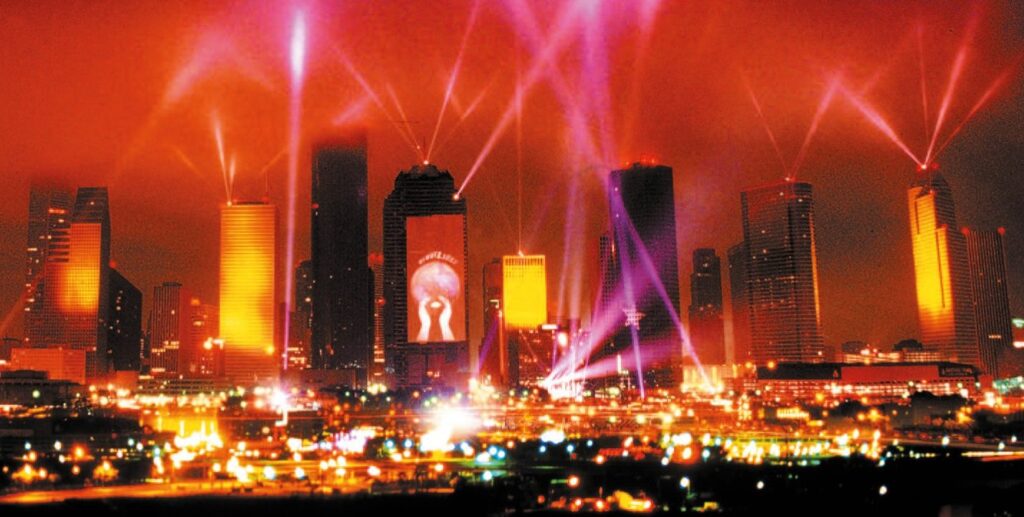
While Jarre was engrossed in creating his next album, Rendez-vous, he received an invitation to perform at a major outdoor concert celebrating the 150th anniversary of Texas in the USA. Ironically, the event also marked the 50th anniversary of NASA. Long fascinated by space exploration and inspired by the possibilities presented by Houston’s striking skyline, Jarre eagerly accepted the invitation.
Jarre’s performance—titled “Rendez-vous Houston”—was his most ambitious concert endeavor to date. His vision involved transforming the Houston skyline into a series of gigantic projection surfaces by attaching massive canvas sheets to the buildings, utilizing their rooftops as a base for elaborate spotlights and launching extravagant fireworks. True to Texas’s reputation for grandeur, Jarre aimed to deliver a fitting show. However, organizing such an enormous event proved to be fraught with challenges: the city’s fire chief attempted to halt the show right up to the concert’s day, citing safety concerns, and torrential rain and high winds repeatedly toppled the massive canvas screens and damaged equipment, necessitating last-minute replacements. The costs associated with staging this concert were staggering.
A remarkable aspect of Jarre’s planning was a musical collaboration with NASA’s latest space mission. The Space Shuttle Challenger was slated to be in orbit during the concert, with saxophonist and scientist Ron McNair aboard. Jarre and McNair devised a plan for a live transmission wherein McNair would perform a piece simultaneously with Jarre’s band during the concert. Unfortunately, this historic collaboration was not to be, as the world mourned when the Challenger exploded shortly after takeoff on January 28, 1986, killing all aboard. Devastated, Jarre contemplated canceling the event; the tragic loss of his friend and collaborator altered the entire purpose of the planned celebration. What was meant to be a joyous occasion now felt like a somber tribute. However, after much reflection, Jarre recognized the importance of proceeding with the show: it would honor Texas’s and NASA’s achievements while serving as a memorial for the Challenger crew. Embracing this perspective, Jarre’s extravagant performance took place on April 5, 1986.
Fortunately, “Rendez-vous Houston” was a tremendous success, serving as both a tribute and celebration—despite the extensive traffic jams surrounding the concert site. Jarre set a new record for concert attendance, with over one million attendees on site, alongside millions who tuned in via television broadcast. The 90-minute concert also ushered in some material from the Rendez-vous album: ‘Second Rendez-vous’ served as a centerpiece to spotlight NASA’s accomplishments, as the audience solemnly watched images of the Challenger disaster projected onto buildings during the haunting performance of ‘Last Rendez-vous’, the track on which McNair was supposed to perform. As both a homage to the fallen astronauts and a celebration of NASA’s achievements, Jarre’s concert resonated with the audience, fulfilling its multifaceted purpose. The triumph of this show opened doors for Jarre to stage more extraordinary performances in the future.
Rendez-vous was released that same month, receiving significantly better reception than its predecessor, undoubtedly aided by the widespread impact of “Rendez-vous Houston”. Aside from a dedication to the Challenger crew on the album sleeve, there’s no explicit mention of the thematic elements; however, it’s apparent that Rendez-vous revolves around humanity’s exploration of space. Ron Grainger’s album cover cleverly echoes the essence of Oxygène, though this time, the imagery reflects the call of the cosmos, transforming Earth into a woman reaching out to the void with cupped hands. Rendez-vous showcases Jarre’s classical influences: especially prominent in the first three tracks, which bear a gothic classical resonance, enriched by distinctive electronic textures. The latter tracks take on a lighter tone, with the fifth track hinting at the starry introspection of ‘Last Rendez-vous’ by commencing with an atmospheric recording of astronaut Bruce McCandless’s breathing, captured during his famed spacewalk. The anthemic ‘Fourth Rendez-vous’ presents an exuberant piece of proto-trance, while ‘Fifth Rendez-vous’ spirals from a meditative opening into frenetic, sequencer-driven chaos, featuring operatic vocals and a cameo from what feels like the Parisian street band from Équinoxe. The melancholic, reflective ‘Last Rendez-vous’ serves as a poignant conclusion and stands as one of Jarre’s most heartfelt works.
With both the album and “Rendez-vous Houston” behind him, Jarre might have found some time to breathe were it not for a call from the Mayor’s office in his hometown of Lyon. They were planning a major event for the visit of Pope Jean Paul II later that year. Would Lyon’s celebrated local be interested in hosting a celebration? Mais oui, bien sur. The resulting event—aptly named “Rendez-vous Lyon”—mirrored the grandeur of its predecessor, with the Mayor’s office addressing the predictable concerns from both city officials and residents. When the Pope blessed Lyon via Jarre’s massive sound system that October, he likely had little idea of what to expect from Jarre’s eclectic mix of musicians and equipment, but the citizens of Lyon welcomed their hometown hero with the exuberance one would expect from such a grand performance.
1987 found Jarre immersed in his next album. While he honed his craft in the studio, Polydor issued a live album featuring highlights from the two “Rendez-vous” concerts, aptly titled Cities In Concert: Houston – Lyon; hour-long video compilations of the shows were also produced, enabling those who had missed the performances to experience Jarre’s grandiose outdoor spectacles, further solidifying his reputation as a showman. Unbeknownst to him, his most spectacular shows were yet to come.
During the development of his new album, Revolutions, Jarre was presented with another intriguing concert opportunity in the UK. The government had heavily invested in revitalizing the derelict Docklands area of London, intending to attract businesses and investment. Jarre, quickly captivated by the area’s industrial heritage and the expansive River Thames, excitedly accepted the engagement. However, he and his governmental sponsors could hardly have anticipated the contentious nature of the proposed show. Local emergency services raised immediate concerns, claiming they couldn’t guarantee timely access to the site in emergencies; the local council subsequently engaged in a protracted and heated battle over health and safety regulations that dragged on for months, even as Jarre and his team pumped millions into planning the elaborate floating stage and concert site. Initially conceived as a free concert, the event had to be significantly scaled back, with a reduced audience size and ticketing announced for two shows in late September 1988. Bureaucratic hurdles continued to complicate matters, leading to postponed dates and ultimately forcing Jarre, his crew, and sponsors to engage in a lengthy legal battle to obtain permission for the concerts to proceed.
Upon Revolutions‘s release, just before the Docklands concerts, it felt like a celebration of hard-earned success. Fueled by the media coverage surrounding the extensive legal challenges, the album soared to the top of the UK charts, securing Jarre’s project’s financial viability.
Revolutions appears, on the surface, to represent Jarre’s most mainstream effort, a notion reinforced by the straightforward portrait of him featured on the cover and the introduction of lead vocals—heavily processed with a vocoder—into his music for the first time. This time around, the thematic focus centered on cultural change, using notable historical periods and events as a backdrop. Beginning with the atmospheric ‘Industrial Revolution’, Jarre tackled various topics: the vibrant 1960s through the Hank Marvin-assisted ‘London Kid’, the economic resurgence in the Far East with the eerie ‘Tokyo Kid’, the rapid rise of IT in the playful ‘Computer Weekend’, the activism of Dulcie September in the African flavored ‘September’, and the plight of those displaced by regime change in the sweeping, Berlioz-influenced ‘The Emigrant’, all woven around ‘Revolutions’ itself, an Eastern-inspired dance track blending Muezzin chant with vocoder-driven vocals and a swirling Arabic riff, which remains one of Jarre’s most accessible tracks for the dancefloor.
Yet, the unpredictable British weather sought to thwart the festivities one last time: during the weekend of the album’s launch, gale-force winds and torrential rains battered the UK, leaving the Docklands site severely affected. The costly PA system suffered damage, instruments were compromised, and rehearsals were disrupted as the tempest refused to relent. Nevertheless, a determined but demoralized team managed to execute the two “Destination Docklands” performances on October 8th and 9th, 1988. The show on the 8th proceeded fairly as scheduled, notwithstanding the absence of some of Jarre’s anticipated visual highlights; conversely, the subsequent show faced relentless rain throughout.
Jarre fought valiantly for the Docklands concerts, and despite the setbacks, the spectacular, albeit damp, performances further solidified his reputation as a showman—an image bolstered by the release of another live album featuring highlights, initially called Jarre Live (later reissued as Destination Docklands, as it perhaps should have been). Thus, at the decade’s conclusion, Jarre’s stature remained elevated. While it may have been a while since the triumph of Oxygène, his subsequent albums received favorable recognition, and his impressive outdoor performances kept him in the media spotlight, sustaining his acclaim. However, true to his inherently restless nature, Jarre felt it was time for a new direction.
Next time: Jarre finds himself viewed as part of the old guard as the rising electronic music scene forges ahead; he attempts touring and stages his most ambitious shows yet; and his passion for remixing and desire to explore new territories puts him at odds with long-time fans…
Feel free to let me know if you’d like any further changes!
Fuente original: echoesanddust.com
Publicado originalmente el 2017-01-11 03:00:00 por
Hashtags sugeridos: #Echoes #Dust #Guide #JeanMichel #Jarre #Part