
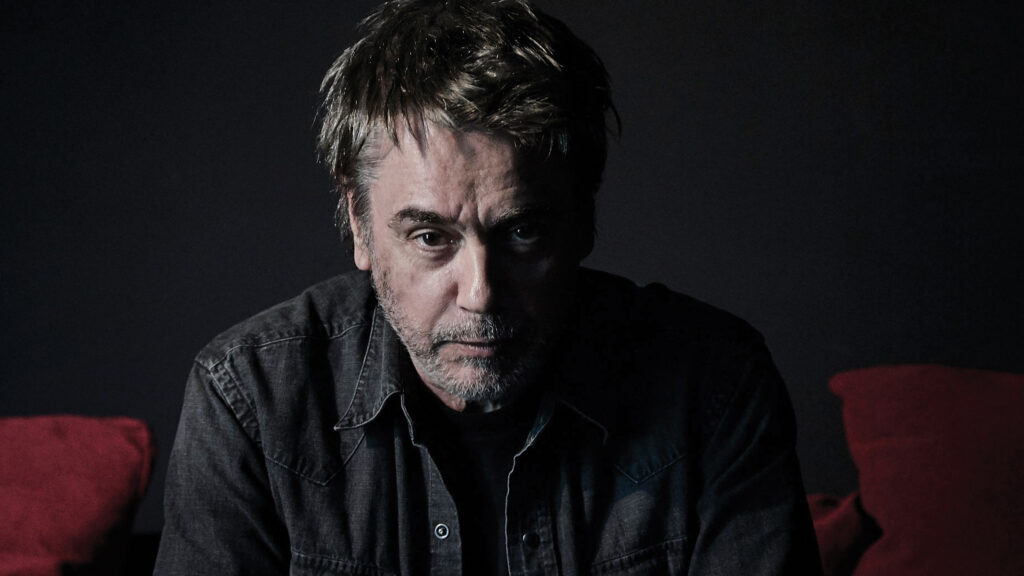
In 2016, Jean-Michel Jarre made headlines with a collaboration featuring ex-CIA “whistleblower” Edward Snowden, coinciding with the release of his latest album Electronica 2: The Heart Of Noise. This followed the previous year’s Electronica 1: The Time Machine, and like its predecessor, which included contributions from Pete Townshend, Tangerine Dream, and John Carpenter, it showcases a diverse array of musical partnerships with both emerging talents and seasoned veterans, from Gary Numan to The Orb, from Pet Shop Boys to Hans Zimmer. Discussing the Snowden track, a remarkably youthful 67-year-old Jarre shared with Prog: “It oddly reminded me of my mother, a notable figure in the French Resistance. She instilled in me that the distinction between traitor and hero is quite subjective and delicate…”
Even prior to his rise to fame, Jarre’s life was nothing short of intriguing. His father, Maurice Jarre, was a titan in film music, earning Oscars for his work on Lawrence Of Arabia, Doctor Zhivago, and A Passage To India. Yet, Jean-Michel had little familiarity with him. “That was out of the picture,” he replied when Prog pressed about his musical lineage, marking the only brief moment of tension in an otherwise lively interview.
Jarre pursued music studies at the Conservatoire de Paris, under the mentorship of Pierre Schaeffer, known as the father of “musique concrete”, and spent time at Stockhausen’s studio.
Captivated by synthesizers, he created a makeshift “studio” in his kitchen. In 1976, he recorded his third album, Oxygène, which initially struggled for release. However, upon its eventual launch—despite scathing reviews—it sold 12 million copies globally. Following Equinoxe two years later, he attracted a record-breaking million attendees at a concert in Place de la Concorde. He later shattered that record with 1.5 million in Houston in 1986 and 2.5 million again in Paris in 1990, culminating in a staggering 3.5 million in Moscow in 1997. His performances became grand spectacles of futuristic visuals, featuring lights, lasers, and fireworks. The 1988 concerts at the then-empty London Docklands, which subjected his fan Princess Diana to atrocious British weather, are etched in local lore.
With over 80 million albums sold, Jarre was the first Western musician to be officially invited to perform in China. Clearly, his electronic/ambient/trance/New Age music, while fundamentally experimental, achieves broad appeal.
In his personal life, he has been anything but ordinary. He wed Charlotte Rampling, his second wife, in 1978, but they separated after nearly two decades. Post a high-profile affair with Isabelle Adjani, he married actress Anne Parillaud in 2005 for five years. Despite this tumultuous history, the man presenting his latest album to a gathered audience in a stylish London club today radiates the enthusiasm of an eager newcomer. He is genuinely excited about his newest project.
During a conversation with Prog, he expresses a desire for feedback, wishing he could ask questions rather than respond. Remembering the nature of public relations, he settles into a discussion about his intriguingly unorthodox music, his connections to the moon, his visual spectacles, and his collaborative ties with prog, Krautrock, cinema, and art. He characterizes his collaboration with The Orb as “a blend of a spacey Pink Floyd vibe and a Marcel Duchamp collage,” while remarking that Hans Zimmer is “my only serious rival in collecting modular synthesizers.” And, of course, there’s the topic of NASA naming an asteroid in his honor…
Jean Michel Jarre in his 1970s heyday (Image credit: Michael Ochs Archives/Getty Images)
The album offers a vast array of sounds and styles, yet overall it feels strikingly contemporary, capturing the essence of 2016 more than expected.
That’s an intriguing point. After spending five years in the studio on two albums, my aim was to produce a work that journeys through the entirety of electronic music while feeling very current in terms of production and sound. This has been a guiding principle for me from the start. Utilizing mixing and digital sounds has become possible in ways that were not available just 10 years ago. I now view digital sounds as capable of competing with the warmth and precision of analogue.
What’s exciting is that we now have digital instruments that can achieve things analogue instruments cannot. It’s a different realm. Virtual synthesizers today can create sounds that a Moog or classic synth simply cannot. I paid great attention to the production, collaborating with people spanning different generations, constantly questioning: “What is the right sound for today?”
When collaborating, do you have to suppress your ego or allow it to flourish? When you’re accustomed to having complete control?
I didn’t dwell on this during the process; it felt very organic. Each artist brought different dynamics. For my part, I prepared by composing music that aligned with my vision of the artist I wished to work with.
I recall discussing this with Pete Townshend early on. I told him: “I’ve crafted something using electronic instruments, reflecting my fantasy of you and The Who.” After all, from Baba O’Riley on Who’s Next, Pete was the pioneer of synthesizers in rock music. I also ensured to leave ample room for him—allowing space for lyrics, singing, and processed guitar riffs—which fostered an immediate connection. I left as much room as possible, not for ego, but for the unique personality and talent of each artist to shine through.
Surprisingly, each artist affirmed that this was my album and that I held the final say. While they wished to hear the final mix and mastering, they trusted me to produce it as I envisioned. I believe this is why it has such coherence. I dedicated considerable time to creating an invisible connection between tracks, ensuring it didn’t feel like a compilation but rather a cohesive whole.
You were a painter in your youth. Does that influence the colors in your music?
Indeed! Visuals have inspired me heavily. When I started in electronic music, there were no precedents; others weren’t doing this. My influences primarily stemmed from films: 2001: A Space Odyssey and many iconic sci-fi films, along with Italian and French cinema from the 50s and 60s, like Fellini. The vibrant pop colors of Technicolor and the stark contrasts of Fritz Lang’s Metropolis also shaped my perspective. Later, abstract painters like Jackson Pollock and Pierre Soulages served as additional inspirations for both my visuals and music…
Your live shows are historic, even legendary. Often described as immense spectacles, they hold records for attendance figures. Do you ever reflect on those evenings and wonder if they actually occurred?
Absolutely! When people ask, I think—was that me? Did I really do that? It’s almost surreal to describe. I felt profoundly privileged to have such dedicated followers and an audience of that size. From the onset, I began contemplating the visualization of electronic music and its representation on stage. It’s not particularly engaging to stand alone before laptops or keyboards for two hours onstage, or merely stare at your equipment. My focus was on integrating visual techniques of my generation with electronics, videos, lighting, and lasers. It was a significant shift. Even in rock and roll at that time, such practices were uncommon.
While you had bands like Pink Floyd and myself, major groups like U2 and The Rolling Stones were just focused on a few lights. Later on, they embraced the complete visual experience. I see parallels in the current electronica scene; festivals like Tomorrowland echo what I pioneered three decades ago, which I find amusing! Initially, I loved rave culture because it resembled my early concerts—transforming a location, forever changing it post-performance, similar to my Docklands show…
Everyone in London seems to have a tale about your ’88 Docklands shows, regardless of the torrential rain. Do you have vivid memories of that experience?
Indeed, to be honest, I think I’ll eventually write a book about it. The behind-the-scenes saga was absolutely wild—so many factors at play: the police, religious sects… and Princess Diana. She was a fan of my music and had expressed she would attend the next UK performance. She said, “The Docklands? No issue, I’ll be there.” However, back then, it was quite a remote area under development.
Thus, we had to construct a Royal Box for security necessitating, which became quite the ordeal. Then the Royal Navy entered the scene; with a sudden storm, the typically calm canal turned choppy, resembling the Atlantic, creating waves. The Navy declared the stage a boat, demanding that everyone wear life jackets. This resulted in the London Symphony Orchestra donning safety gear—it was all so absurd and chaotic. It was completely outside the norm.
(Image credit: Photo by Getty)
Outside the norm?
Exactly! That phrase resonates because, when I reflect on all my collaborators from these two recent albums—some are famous legends while others are newcomers—they all share a slight outsider quality. That’s the right term. I could have aptly titled the entire project Outsiders.
When Oxygène emerged in the ’70s, it resonated as music from the future. While you reference outsiders, electronica has grown to be the dominant sound of the 21st century. What was once futuristic now feels familiar. Did you foresee this level of success back then?
Honestly, I had no foresight at all. However, I was convinced that electronic music would transform the world, which is why I committed to its early development. For one straightforward reason: unlike punk, rock, or hip-hop, it’s not tied to any single music genre. It’s merely a different approach to composition. It conceptualizes music first and foremost through sounds, rather than just notes. This fundamentally shifted our perspective on creating music. We became sound designers. A DJ today is, at their core, a sound designer. Music resembles cooking; our role is to blend frequencies and waveforms in an organic, sensual manner—some sounds simmer, others boil…
Didn’t you once express a desire for your music to evoke the feeling of going to the Moon?
Indeed! It’s intriguing how electronic music is often associated with space and the future, even if that wasn’t my intention. My compositions aimed more for a soundscape hovering between ground level and the clouds—about 10 meters above the Earth, rather than “outer” space…
Yet, it’s amusing how I remain connected to space. I became good friends with Arthur C. Clarke after he wrote 2010: Odyssey Two, the sequel to 2001…. A huge fan of the original book, I was surprised to find my name in the acknowledgments; he penned it while listening to my music. This led to correspondence pre-internet, developing into a friendship. He once said, “Jean-Michel, you will perform on the Moon one day!” I responded, “Return to Earth, Arthur; that’s impossible!” He replied, “Ah, maybe not right now…but you should aim to project something onto the Moon during your performance; that’s feasible…”
Eventually, I hosted a concert in Houston in partnership with NASA, coinciding with the Challenger tragedy involving the Space Center. Furthermore, I later performed in Moscow where I discovered cosmonauts were playing my album Equinoxe in space—they claimed it was their favorite music up in orbit. This connection has always existed naturally, without any push from my end.
Did progressive rock influence you at all? You mentioned Pink Floyd, and your music has stretched boundaries…
Absolutely! I’ve always sensed a kinship with early Pink Floyd. We were likely the first two to begin crafting audio-visual statements in our live performances. I recall Nick Mason once saying, “Oh no, Pink Floyd is stopping; we’ll let Jean-Michel take over the big outdoor shows now…”
There’s a strong connection between prog rock and electronic music. Early electronic artists in Germany, such as Can and Tangerine Dream, were first rooted in prog rock. When I collaborated with Edgar Froese from Tangerine Dream, he acknowledged we began around the same time. While I conceded that I started in electronic music prior, he humbly pointed out that they were still evolving as a prog rock band. I spoke with Bobby Gillespie on a Berlin to London flight, and he described Primal Scream as a “prog rock punky noise band.” There are connections everywhere! Progressive elements have woven their way into artists like Nine Inch Nails, especially in relation to sound processing. And of course, there’s Krautrock with its hypnotic, trance-like ambiance that aligns with my style…
Indeed. Your early works sculpted repetition, motifs, almost like mantras…
Definitely, and you can observe this in Indian music, in the works of Terry Riley, in jazz, or Philip Glass. Repetition serves as a motif; Johann Sebastian Bach was the maestro of sequences! We owe so much to Pierre Schaeffer, who first declared in the late ’40s that music should revolve around sounds and noises, not solely notes. He experimented with recording loops, manipulating speeds and reverses even before tape recorders were prevalent! Frippertronics, the Fripp and Eno collaboration? Schaeffer was pioneering such techniques 30 years earlier! When I studied music, this was our approach. We learned that electronic music originated primarily in Germany and France, notably with Schaeffer, Stockhausen—distinct from American pop or blues. When John Foxx presented me an award years ago, he pointed out how British artists had been heavily influenced by American sounds, though Oxygène emerged as a fresh twist on European roots.
Do you identify as distinctly European?
I share a profound connection with England, a nation I cherish deeply. The mother of my children, Charlotte Rampling, is English, and my kids are half-English, half-French. However, I’ve retained my French accent! I admire the national pride Britain showcases. The 2012 London Olympics opening ceremony epitomized how a country should present itself—faithful to its values while embracing self-critique. I appreciate the subversive spirit. Certainly, I feel European and, admittingly, a global citizen, given my extensive travels. I relate to the Pet Shop Boys’ lyrics, which evoke memories of my roots in Lyon, my hometown. The struggles and emotions of both wealthy and impoverished individuals resonate universally, yet possess a distinctly European flavor.
Has fame altered your worldview? Given your high-profile relationships, you became a target for tabloids…
Honestly, no. I’ve been fortunate. When success arrived, I was married to an extraordinary woman, Charlotte, with whom I share a fantastic relationship. We’ve managed to distance ourselves from the drama. I perceive fame or success, akin to failure, as mere accidents of life. That’s the lesson we impart to our children: don’t be entrapped by success or failure like a deer caught in headlights. A simple yet true philosophy.
While the Edward Snowden track has stirred up discussions, there were also rumors of a collaboration with David Lynch. Did that materialize?
Well, he was the initial respondent to the project, and he has been incredibly pleasant. I sent him three tracks, and he mixed them into one piece! I then worked on it, but we mutually agreed it wasn’t quite right. Subsequently, he began working on Twin Peaks. We decided to revisit the collaboration after Twin Peaks concludes. Hopefully, we’ll explore this again.
You have numerous major festivals and shows lined up this year. Can we expect a visual extravaganza?
I’m currently developing it! The challenge is that audiences expect substantial visual elements due to my history. Festivals have a “communal” ethos, where all performances share a common platform. I’m striving to create an engaging cinematic production that doesn’t require 40 trucks! After five years in the studio, the mere concept of opening up is already quite overwhelming. I simply hope it aligns with the sensibilities of 2016—I aim to contribute to the future, not revisit the past.
You are the first individual I’ve met to have an asteroid named in your honor…
Indeed, but it’s rather an unattractive one! Not a particularly beautiful stone. Still, it is an accomplishment, I suppose. It bears the designation 4422. While at NASA, they informed me of the naming, and I felt immense pride, although I hoped it would maintain a safe distance; we definitely don’t want it orbiting too close. Whether it’s male or female is uncertain—its shape complicates that determination…
Fuente original: www.loudersound.com
Publicado originalmente el 2023-08-24 07:00:00 por
Hashtags sugeridos: #remember #Nick #Mason #Pink #Floyd #stopping #leave #big #outdoor #concerts #JeanMichel #Jarre #argues #contribute #tomorrow #yesterday